
What is Elicit?
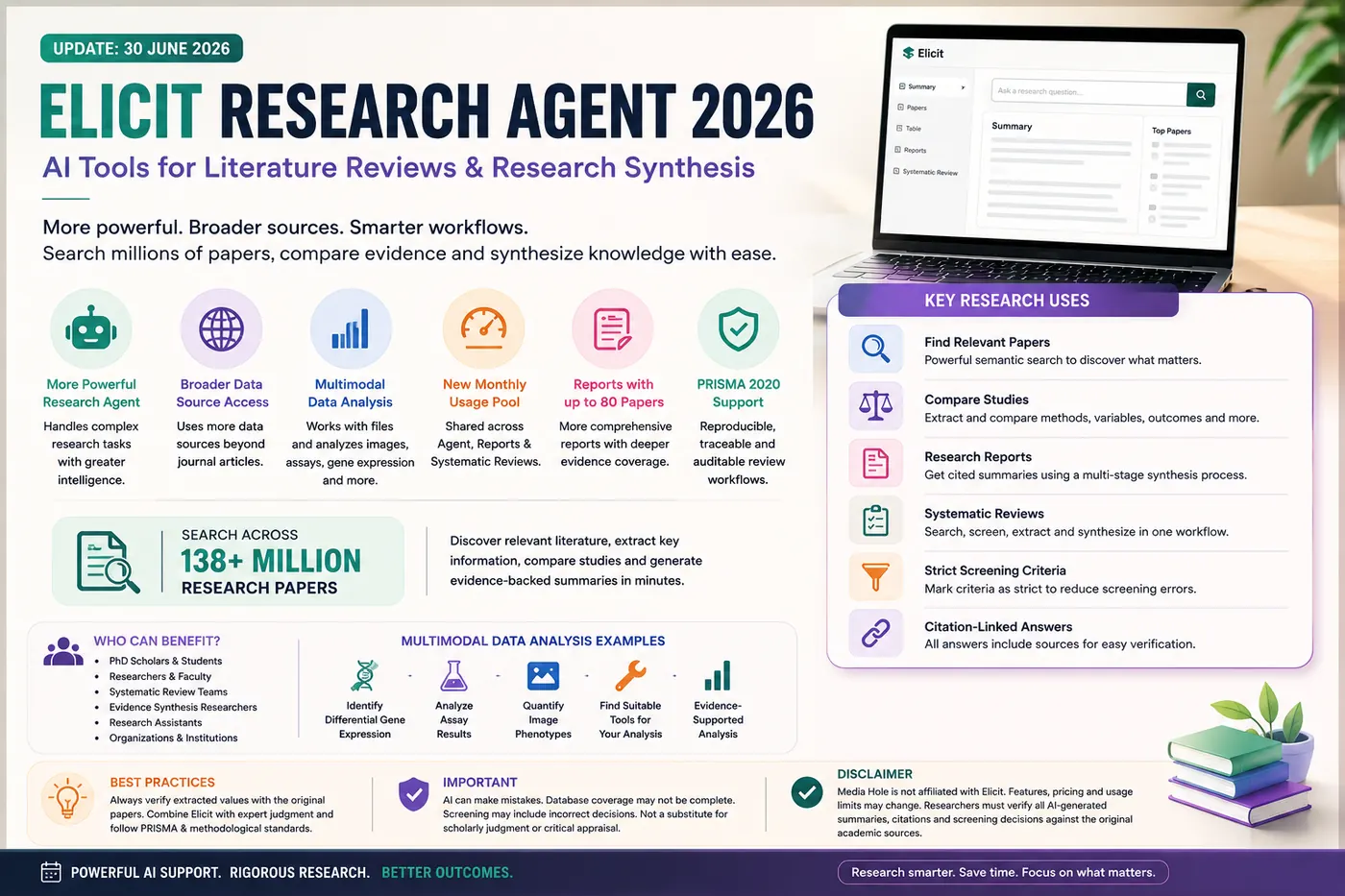
Elicit is an AI-powered research platform designed to help researchers search for papers, compare studies, extract structured information and prepare evidence-based research summaries.
The platform is intended to support literature reviews, systematic reviews, research-landscape analysis, evidence synthesis and other research workflows.
Elicit can search across more than 138 million academic papers. Its search and extraction tools allow researchers to identify relevant publications, compare study characteristics and examine evidence across multiple papers.
What is the Elicit Research Agent?
The Research Agent is designed for complex research questions that require more than a simple paper search.
Instead of only retrieving and summarising documents, it can break a research question into a series of research tasks, identify relevant sources and prepare a structured output grounded in evidence.
Depending on the user’s plan and selected workflow, the Research Agent may use sources beyond academic journal articles, including:
- Clinical-trial records
- Regulatory documents
- Press releases
- Product information
- Technical documents
- Publicly available web sources
- Files uploaded by the researcher
What changed in the June 2026 update?
Elicit announced a more powerful Research Agent on 30 June 2026.
The main changes include:
- Ability to complete more extensive research tasks
- Access to a broader range of data sources
- Multimodal data-analysis capabilities
- A new monthly usage pool
- Shared usage across Research Agent, Reports and Systematic Literature Reviews
- Usage levels that vary according to the selected subscription plan
The revised usage system began rolling out from 1 July 2026.
Multimodal data analysis
The upgraded Research Agent can work with certain research files and data-analysis tasks in addition to literature-based questions.
Elicit gives examples such as:
- Identifying differential gene expression
- Analysing assay results
- Quantifying image phenotypes
- Finding appropriate technical tools for a research-analysis task
- Returning an evidence-supported analysis
These advanced features may be particularly relevant to scientific and biomedical research. Researchers in the humanities and social sciences may find its literature-search, report-generation and evidence-extraction features more directly useful.
Key research uses
1. Literature searching
Researchers can enter a natural-language research question and search across a large collection of academic papers.
This may help users:
- Discover relevant studies
- Identify related terminology
- Locate highly relevant papers
- Explore unfamiliar research areas
- Build an initial reading list
2. Paper comparison
Elicit can organise papers in a table and extract information into columns.
Depending on the research question, users may compare:
- Sample characteristics
- Research methods
- Variables
- Interventions
- Outcomes
- Study locations
- Theoretical frameworks
- Limitations
- Main findings
Researchers must still verify extracted information against the original paper.
3. Research Reports
Elicit Reports generate structured research summaries based on a research question.
The reports use a multi-stage evidence-synthesis process that may include:
- Identifying relevant papers
- Screening the evidence
- Assessing eligibility
- Selecting papers for synthesis
- Producing a cited summary
Elicit states that each stage is documented and auditable.
4. Systematic literature reviews
Elicit provides a dedicated systematic-review workflow for searching, screening, extracting information and synthesising evidence.
The workflow can support:
- Research-question refinement
- Search-strategy development
- Abstract screening
- Full-text screening
- Inclusion and exclusion criteria
- Data extraction
- Evidence tables
- Review reports
The exact limits and features depend on the user’s subscription plan.
5. PRISMA 2020 support
In May 2026, Elicit announced that its Systematic Review workflow supports PRISMA 2020 guidelines.
The company describes the workflow as reproducible, traceable and auditable at every stage.
This can assist researchers in documenting:
- Search decisions
- Screening decisions
- Inclusion and exclusion decisions
- Extracted evidence
- Sources used in the final synthesis
However, using Elicit does not automatically make a review PRISMA-compliant. Researchers remain responsible for following all applicable PRISMA requirements and accurately reporting their methods.
6. Strict screening criteria
Elicit allows users to mark important inclusion or exclusion criteria as strict.
A paper that fails a strict criterion can be automatically excluded, while the researcher can review and override decisions where necessary.
This may help researchers apply screening rules more consistently, but automatic decisions should still be checked manually.
7. Reports using up to 80 papers
For eligible paid plans, Elicit’s Systematic Review reports can use up to 80 papers in the final generated synthesis.
This feature is intended to make reports more comprehensive than summaries based on a smaller group of studies.
The 80-paper report feature is associated with eligible Pro, Teams and Enterprise access and should not be assumed to be included in every plan.
8. Citation-linked answers
Elicit provides sources for its answers and research summaries.
This allows users to inspect the supporting papers rather than relying only on the AI-generated text.
Researchers should open the cited papers, read the relevant sections and confirm that each source actually supports the stated conclusion.
Who may find Elicit useful?
- PhD scholars
- Research students
- Faculty members
- Systematic-review teams
- Evidence-synthesis researchers
- Medical and public-health researchers
- Social-science researchers
- Policy researchers
- Research assistants
- Organisations conducting research-landscape analysis
Potential uses in media and communication research
Media and communication researchers could use Elicit to explore questions related to:
- Artificial intelligence and journalism
- Misinformation and fact-checking
- News credibility
- Audience engagement
- Social-media use
- Digital literacy
- Political communication
- Media effects
- Immersive media
- Virtual reality in education
- Spatial audio and learning
- Journalism education
- Platform governance
- Online communities
For example, a researcher studying immersive sound in education could search for papers on binaural audio, spatial presence, virtual-reality engagement and learning outcomes, and then compare methods, samples and reported findings.
Free plan
Elicit currently offers a Basic plan without a subscription charge.
The official pricing page states that the Basic plan includes:
- Limited Research Agent usage
- Limited access to Research Reports
- Unlimited search across more than 138 million papers
- Unlimited paper summaries
- Unlimited chat with papers where full text is available
- Source visibility for answers
- Zotero import
The number of automated reports, usage allocation and other limits may change, so users should verify the current pricing page before relying on a specific allowance.
Paid plans
Elicit also offers paid plans with increased usage and additional features.
Paid features may include:
- Higher Research Agent usage
- More Research Reports
- Systematic Literature Review access
- Larger screening capacity
- Additional extraction columns
- Export to formats such as CSV, RIS, PDF, DOCX or BibTeX-compatible workflows
- Team collaboration
- API access or enterprise services
Pricing, feature limits and annual or monthly billing terms may change.
What Elicit should not replace
Elicit should support research work, not replace scholarly judgement.
It should not replace:
- Reading original papers
- Database-specific searching
- Manual citation checking
- Critical appraisal
- Quality assessment
- Risk-of-bias assessment
- Methodological expertise
- Subject expertise
- Human decisions about inclusion and exclusion
- Transparent reporting of the final review process
Important limitations
1. AI-generated errors
Elicit may misinterpret a paper, extract incorrect information or produce an incomplete synthesis.
2. Incomplete literature coverage
Searching a large paper database does not guarantee that every relevant study will be retrieved.
Researchers may still need to search specialised databases such as Scopus, Web of Science, PubMed, ERIC, PsycINFO, Communication Source or other discipline-specific resources.
3. Full-text availability
Some analysis features depend on whether the full text of a paper is available.
4. Screening errors
Automated screening may incorrectly include or exclude studies.
5. Citation problems
A cited paper may not fully support the wording used in an AI-generated answer.
6. Disciplinary variation
Features designed for biomedical evidence synthesis may not always transfer directly to qualitative, interpretive or humanities-based research.
7. Subscription limits
Advanced workflows, larger reports and systematic-review features may require a paid plan.
Responsible research workflow
Researchers can use the following workflow:
1. Define a clear research question.
2. Use Elicit to explore keywords and identify initial papers.
3. Search additional academic databases independently.
4. Review titles and abstracts manually.
5. Open and read the original full-text papers.
6. Verify every extracted value and AI-generated summary.
7. Document the complete search and screening process.
8. Conduct formal quality or risk-of-bias assessment where required.
9. Maintain a reference manager such as Zotero.
10. Disclose the use of AI tools when required by the institution, supervisor or journal.
Research integrity and AI disclosure
Researchers should check whether their institution, funding body or target journal requires disclosure of AI-assisted research tools.
Elicit should not be listed as an author.
Researchers remain fully responsible for:
- Accuracy
- Citations
- Interpretation
- Confidentiality
- Research ethics
- Copyright compliance
- Final written content
- Methodological transparency
Users should avoid uploading confidential, unpublished or personally identifiable research material unless they have reviewed the platform’s current privacy and data-handling terms.
Conclusion
Elicit can reduce some of the manual work involved in finding, comparing and organising research literature.
Its upgraded Research Agent, broader data access, paper-search tools and PRISMA-oriented systematic-review workflow make it useful for literature exploration and evidence synthesis.
However, AI-generated outputs should be treated as research assistance rather than verified academic evidence. Every important statement, citation, extracted value and screening decision should be checked against the original source.
How to apply
Media Hole is not affiliated with Elicit; features, pricing and usage limits may change, and researchers must verify AI-generated summaries, citations, extracted data and screening decisions against the original academic sources.