
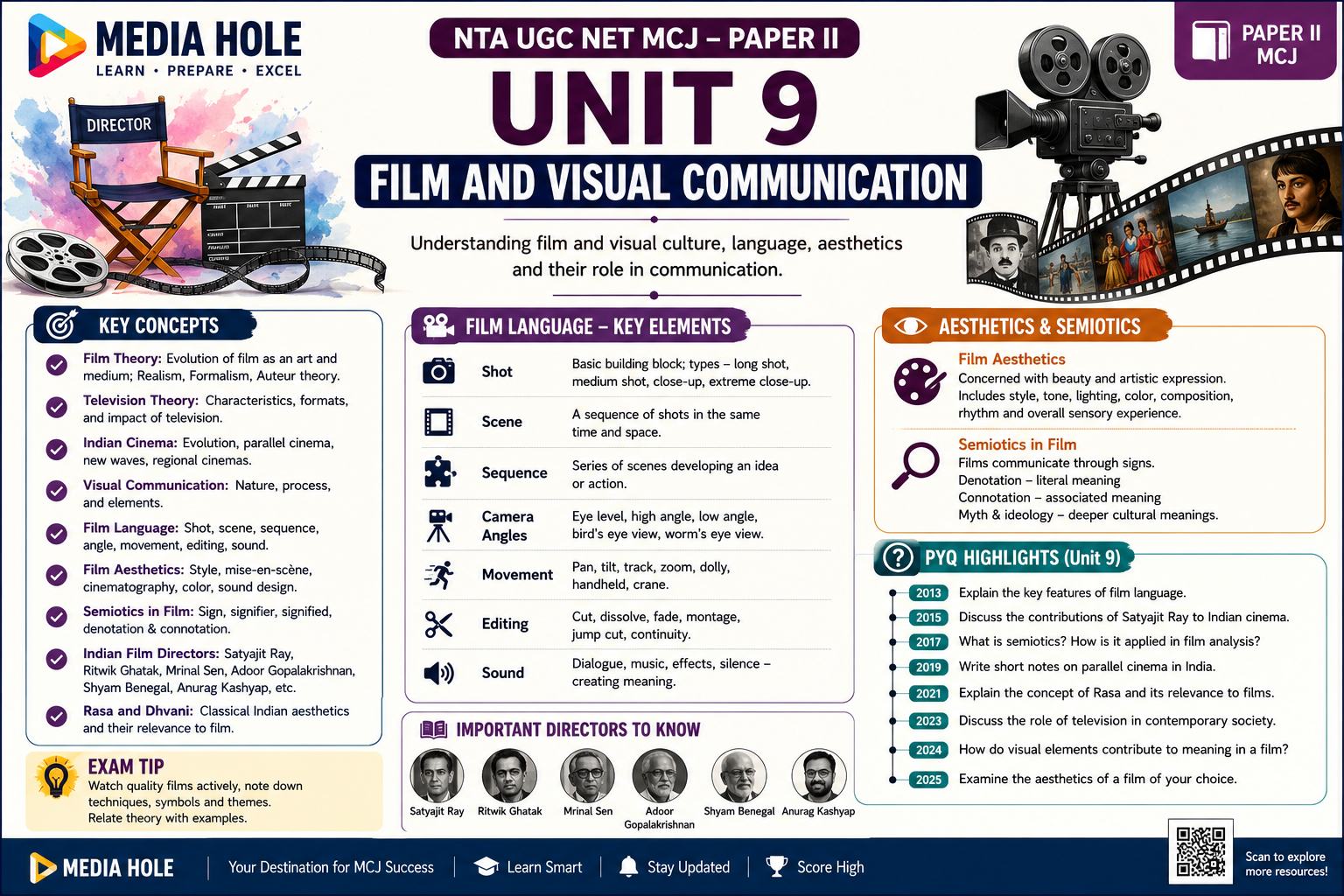
Unit 9 Complete Notes: Film and Visual Communication
1. Unit 9 at a Glance
| Syllabus Area | What to Prepare | PYQ Importance |
|---|---|---|
| Film and television theory | Film language, montage, realism, auteur theory, semiotics, representation and audience reading. | Important for theory-author and concept questions. |
| Indian cinema | Early cinema, silent era, talkies, studio era, commercial cinema, parallel cinema and 21st-century cinema. | Repeated through film-director and chronology questions. |
| Leading directors | Dadasaheb Phalke, Ardeshir Irani, V. Shantaram, Satyajit Ray, Guru Dutt, Bimal Roy, K. Asif, Mrinal Sen, Ritwik Ghatak, Shyam Benegal and others. | Direct matching questions appear frequently. |
| Visual communication | Signs, symbols, icons, colour, composition, perspective, gaze, visual grammar and meaning-making. | Asked through semiotics and visual analysis questions. |
| Film language and aesthetics | Shot, scene, sequence, camera angle, lighting, sound, editing, mise-en-scene and narrative structure. | Common technical PYQ area. |
| Indian aesthetics | Rasa, Dhvani, Natyashastra, emotion, suggestion, performance and poetic meaning. | Useful for syllabus-specific conceptual questions. |
2. Infographic Flow: Film Meaning-Making
3. Meaning of Film and Visual Communication
Film is an audio-visual medium that communicates through moving images, sound, performance, editing and narrative. Visual communication is the process of creating and interpreting meaning through visual signs such as images, colours, typography, symbols, layout, camera angle and composition.
| Medium / Concept | Communication Role |
|---|---|
| Film | Uses moving images, sound and editing to tell stories and express ideas. |
| Television | Combines visual immediacy, seriality, news, entertainment and flow. |
| Visual communication | Uses images, signs, colours and design to communicate meaning. |
| Visual analysis | Studies how visual elements create meaning, ideology, emotion and identity. |
4. Basics of Film Language
| Film Language Term | Meaning |
|---|---|
| Frame | The single visual unit or boundary of the image. |
| Shot | A continuous recording between camera start and stop. |
| Scene | A dramatic unit usually occurring in one place and time. |
| Sequence | A group of scenes forming a larger narrative unit. |
| Mise-en-scene | Everything placed before the camera: setting, costume, lighting, actors, objects and composition. |
| Cinematography | Art and technique of camera work, lighting, lens, framing and movement. |
| Editing | Arrangement of shots to create continuity, rhythm, contrast or meaning. |
| Sound design | Use of dialogue, music, effects, ambience and silence. |
5. Shot Size, Camera Angle and Composition
| Term | Meaning / Effect |
|---|---|
| Long shot | Shows subject with environment. |
| Medium shot | Shows subject partly, often from waist or chest level. |
| Close-up | Emphasises emotion, face or detail. |
| High angle | Camera looks down; subject may appear weak or small. |
| Low angle | Camera looks up; subject appears stronger, imposing or authoritative. |
| Eye-level shot | Neutral and natural perspective. |
| Rule of thirds | Composition principle dividing frame into thirds for balanced placement. |
| Lead room / nose room | Space in front of a moving or looking subject. |
6. Lighting, Colour and Visual Mood
Lighting creates visibility, mood, depth, emotion and meaning. Colour can suggest mood, identity, symbolism, genre and cultural meaning.
| Lighting / Colour Term | Meaning |
|---|---|
| Key light | Main light source. |
| Fill light | Reduces shadows created by key light. |
| Back light | Separates subject from background. |
| High-key lighting | Bright, low contrast and cheerful visual style. |
| Low-key lighting | Dark, high contrast and dramatic visual style. |
| Colour symbolism | Use of colour to express emotion, culture or idea. |
7. Film Sound
| Sound Term | Meaning |
|---|---|
| Dialogue | Speech by characters. |
| Music | Song, score or background music. |
| Sound effects | Artificial or recorded sounds supporting action. |
| Ambient sound | Background sound of environment. |
| Diegetic sound | Sound whose source exists inside the story world. |
| Non-diegetic sound | Sound outside the story world, such as background score. |
| Voice-over | Narration or commentary heard over visuals. |
8. Editing and Montage
Editing arranges shots to create continuity, rhythm, emotional effect, contrast and meaning. Montage is a style or technique where the arrangement of shots creates meaning beyond individual images.
| Editing Technique | Meaning |
|---|---|
| Cut | Instant transition from one shot to another. |
| Fade | Image appears from or disappears into black/white. |
| Dissolve | One image gradually changes into another. |
| Jump cut | Discontinuous cut that creates a jump in time or movement. |
| Parallel editing | Alternating between two or more actions occurring simultaneously. |
| Montage | Meaning created through juxtaposition of shots. |
| Non-diegetic insert | Image inserted that is not part of intended story narration or story world. |
9. Film and Television Theory
| Theory / Approach | Main Idea |
|---|---|
| Realism | Film represents life, society and reality with minimal artificiality. |
| Formalism | Film creates meaning through form, style, editing, framing and construction. |
| Montage theory | Meaning arises from collision or arrangement of shots. |
| Auteur theory | Director is treated as the creative author of the film. |
| Semiotic approach | Studies film and television as systems of signs. |
| Feminist film theory | Studies gender, gaze, representation and power in cinema. |
| Psychoanalytic approach | Studies desire, identification, unconscious and spectatorship. |
| Reception approach | Studies how audiences interpret television or film texts. |
10. Semiotics and Visual Analysis
Semiotics is the study of signs and meaning. In visual communication, semiotics helps analyse images, symbols, advertisements, television visuals, films and cultural texts.
| Semiotic Term | Meaning |
|---|---|
| Sign | Anything that stands for something else. |
| Signifier | The form of the sign: image, sound, word or symbol. |
| Signified | The concept or meaning associated with the signifier. |
| Icon | Sign resembling what it represents. |
| Index | Sign physically or causally connected to its object. |
| Symbol | Sign based on convention or learned meaning. |
| Myth | Cultural meaning or ideology naturalised through signs. |
11. Indian Cinema: Early Development
Indian cinema developed from early silent films to talkies, studio productions, nationalist and social themes, post-Independence realism, popular Hindi cinema and regional film movements.
| Milestone / Film | Revision Point |
|---|---|
| Raja Harishchandra | Often recognised as the first full-length Indian feature film; associated with Dadasaheb Phalke. |
| Pundalik | Early Indian film associated with R. G. Torney in PYQ matching. |
| Alam Ara | First Indian talkie; associated with Ardeshir Irani. |
| Pather Panchali | Satyajit Ray’s landmark film in Indian and world cinema. |
| Do Bigha Zamin | Bimal Roy film; important in social realist cinema. |
| Pyaasa | Guru Dutt film; important in Indian film aesthetics and social critique. |
| Mughal-e-Azam | K. Asif’s historical epic. |
12. Early World Cinema PYQ Names
| Figure / Film | Revision Point |
|---|---|
| Lumiere Brothers | Arrival of a Train is linked with early cinema exhibition. |
| Georges Melies | A Trip to the Moon; fantasy and special effects. |
| Edwin S. Porter | The Great Train Robbery; early narrative editing. |
| R. G. Torney | Pundalik in PYQ matching pattern. |
13. Leading Indian Film Directors and Works
| Director | Important Work / Area |
|---|---|
| Dadasaheb Phalke | Raja Harishchandra; father of Indian cinema. |
| Ardeshir Irani | Alam Ara. |
| V. Shantaram | Jhanak Jhanak Payal Baaje and social/cultural cinema. |
| P. C. Barua | Devdas-era cinema; Maya appears in PYQ matching pattern. |
| Satyajit Ray | Pather Panchali; Apu Trilogy; Indian art cinema. |
| Guru Dutt | Pyaasa; visual lyricism and social critique. |
| Bimal Roy | Do Bigha Zamin; social realism. |
| K. Asif | Mughal-e-Azam. |
| Muzaffar Ali | Umrao Jaan. |
| Ritwik Ghatak | Partition, displacement and Bengali parallel cinema. |
| Mrinal Sen | Political modernism and parallel cinema. |
| Shyam Benegal | New Indian cinema and parallel cinema. |
14. Commercial and Non-commercial Cinema
| Commercial Cinema | Non-commercial / Parallel Cinema |
|---|---|
| Market-oriented and entertainment-driven. | Issue-oriented, realist, artistic or experimental. |
| Uses stars, songs, spectacle and genre formulas. | Uses realism, social themes and character-based storytelling. |
| Box-office success is central. | Critical, cultural and artistic value is central. |
| Often follows dominant film paradigm. | Often challenges dominant narrative and style. |
15. Dominant Film Paradigm
The dominant film paradigm usually refers to the mainstream narrative form that emphasises clear storytelling, continuity editing, character motivation, cause-effect structure, closure and audience identification.
| Feature | Meaning |
|---|---|
| Continuity editing | Editing hides cuts and maintains smooth story flow. |
| Cause-effect narrative | Events are connected by character goals and conflicts. |
| Closure | Story reaches a clear conclusion. |
| Identification | Audience emotionally connects with characters. |
16. Hindi Film Song
Hindi film songs are central to Indian popular cinema. Songs support narrative, emotion, romance, memory, spectacle, marketing and star image. They often work as emotional punctuation within the film.
| Function of Film Song | Meaning |
|---|---|
| Narrative function | Moves the story forward or marks a turning point. |
| Emotional function | Expresses love, sorrow, celebration or longing. |
| Star function | Builds star image and screen persona. |
| Commercial function | Promotes the film through music circulation. |
| Cultural function | Connects with festivals, rituals, language, memory and identity. |
17. Indian Cinema after Independence
Post-Independence Indian cinema included nation-building themes, social realism, melodrama, regional cinemas, the rise of parallel cinema and the growth of mainstream popular Hindi cinema.
| Trend | Revision Point |
|---|---|
| Nation-building cinema | Films dealing with development, poverty, social reform and modern India. |
| Social realism | Focus on rural life, inequality and ordinary people. |
| Parallel cinema | Art cinema tradition with realism and social criticism. |
| Popular Hindi cinema | Song, dance, melodrama, romance, action and star culture. |
| Regional cinema | Strong film traditions in Bengali, Malayalam, Tamil, Telugu, Marathi and other languages. |
18. Indian Cinema in the 21st Century
| Trend | Meaning |
|---|---|
| Multiplex cinema | Urban, niche and segmented audiences. |
| OTT platforms | Streaming distribution and new viewing patterns. |
| Pan-Indian cinema | Films crossing regional-language markets. |
| Digital filmmaking | Digital cameras, editing, VFX and online distribution. |
| Independent cinema | Small-budget films with festival, OTT or niche audiences. |
| New representation debates | Gender, caste, region, identity, religion and politics in film narratives. |
19. Approaches to Analysis of Indian Television
| Approach | What It Studies |
|---|---|
| Textual analysis | Visuals, narrative, characters, genre, language and ideology. |
| Audience analysis | How viewers interpret and use television content. |
| Political economy | Ownership, advertising, regulation, markets and power. |
| Cultural studies approach | Identity, representation, class, caste, gender, region and everyday life. |
| Genre analysis | News, serials, reality shows, sports, mythologicals and comedy formats. |
| Semiotic analysis | Signs, symbols, myths and visual codes in television. |
20. Indian Aesthetics: Rasa and Dhvani
Indian aesthetics is important for understanding performance, emotion, poetry, drama and cinema. Rasa refers to aesthetic emotion or flavour experienced by the audience. Dhvani refers to suggestion or implied meaning beyond literal expression.
| Concept | Meaning | Film Relevance |
|---|---|---|
| Rasa | Aesthetic emotion or flavour experienced by the viewer. | Explains emotional experience in performance and cinema. |
| Bhava | Emotion or state expressed by performer. | Actor performance creates emotional response. |
| Dhvani | Suggestion or implied meaning. | Film can suggest meaning through image, silence, music or symbol. |
| Natyashastra | Classical Indian text on performance and aesthetics. | Basis for rasa theory and performance analysis. |
21. Visual Communication: Elements and Principles
| Visual Element | Meaning / Use |
|---|---|
| Line | Guides eye movement and creates direction. |
| Shape | Creates structure and visual identity. |
| Colour | Creates mood, symbolism and emphasis. |
| Texture | Suggests surface quality and visual depth. |
| Space | Controls balance, clarity and emphasis. |
| Typography | Communicates tone, hierarchy and readability. |
| Balance | Distribution of visual weight. |
| Contrast | Difference that creates visibility and emphasis. |
22. Documentary, Soap Opera and Television Forms
| Form | Meaning |
|---|---|
| Documentary | Non-fiction film or television form dealing with real people, places and issues. |
| Soap opera | Serial drama form, historically linked with commercial sponsorship. |
| Reality television | Unscripted or semi-scripted formats involving real participants or situations. |
| Telefilm | Film made for television. |
| Docudrama | Drama based on real events. |
23. PYQ Mapping Table
| PYQ Source | Question Area | What to Revise |
|---|---|---|
| September 2013 Paper II | Raja Harishchandra | First Indian feature film area; length of Raja Harishchandra asked. |
| September 2013 Paper II | Early cinema matching | Lumiere–Arrival of a Train, Edwin S. Porter–The Great Train Robbery, Melies–A Trip to the Moon, R. G. Torney–Pundalik. |
| September 2013 Paper II | Indian film-director matching | Jhanak Jhanak Payal Baaje–V. Shantaram, Alam Ara–Ardeshir Irani, Pather Panchali–Satyajit Ray. |
| June 2014 Paper III | Film-director matching | Pyaasa–Guru Dutt, Mughal-e-Azam–K. Asif, Umrao Jaan–Muzaffar Ali, Do Bigha Zamin–Bimal Roy. |
| September 2013 Paper II | Visual composition | Low angle shot makes subject strong/imposing; gaze motion and S-shaped eye movement. |
| September 2013 Paper II | Lighting and video signals | Intensity, colour, dispersion and direction = lighting; composite/component/RGB = video signals. |
| June 2014 Paper III | Semiotics and television | Objective of semiotics in television: identify/deconstruct mythic structures. |
| June 2014 Paper III | Structuralism and Barthes | Structuralism from Ferdinand de Saussure; Barthes’ myth as communication system. |
| June 2014 Paper III | Non-diegetic insert | Images not part of intended narration. |
| June 2014 Paper III | Soap opera | Procter & Gamble funded first audio-visual soap opera format area. |
| November 2017 Paper III | Film content management | Movie industry and content management/copy protection in broadcast/digital context. |
| September 2016 Paper III | Textual analysis | Roland Barthes, binary opposition and textual analysis area. |
24. Frequently Repeated PYQ Areas
25. Quick Revision Sheet
| Term | One-line Revision |
|---|---|
| Film language | System of shots, sound, editing and performance used to create meaning. |
| Mise-en-scene | Everything placed before the camera. |
| Montage | Meaning created through arrangement of shots. |
| Low angle shot | Makes subject appear strong or authoritative. |
| Non-diegetic sound | Sound outside the story world. |
| Non-diegetic insert | Image not part of intended narration/story world. |
| Semiotics | Study of signs and meaning. |
| Saussure | Signifier and signified; structuralist tradition. |
| Barthes | Myth and cultural meaning in signs. |
| Rasa | Aesthetic emotion experienced by the audience. |
| Dhvani | Suggested or implied meaning. |
| Parallel cinema | Realist, issue-based and non-mainstream Indian cinema tradition. |
26. Practice Questions with PYQ Angle
Answer: Low angle shot.
PYQ Angle: September 2013 Paper II.
Answer: Satyajit Ray.
PYQ Angle: September 2013 Paper II.
Answer: Guru Dutt.
PYQ Angle: June 2014 Paper III.
Answer: Alam Ara.
PYQ Angle: September 2013 Paper II.
Answer: To identify and deconstruct mythic structures.
PYQ Angle: June 2014 Paper III.
Answer: Ferdinand de Saussure.
PYQ Angle: June 2014 Paper III.
Answer: Aesthetic emotion or flavour experienced by the audience.
PYQ Angle: Indian aesthetics and poetics area.
27. Final Exam Tip
For Unit 9, revise through five tables: film-director matching, early cinema chronology, film language terms, semiotics and visual analysis, and Indian aesthetics. PYQs usually test this unit through film names, directors, shot/lighting terms, semiotics, visual grammar and Indian cinema milestones.