
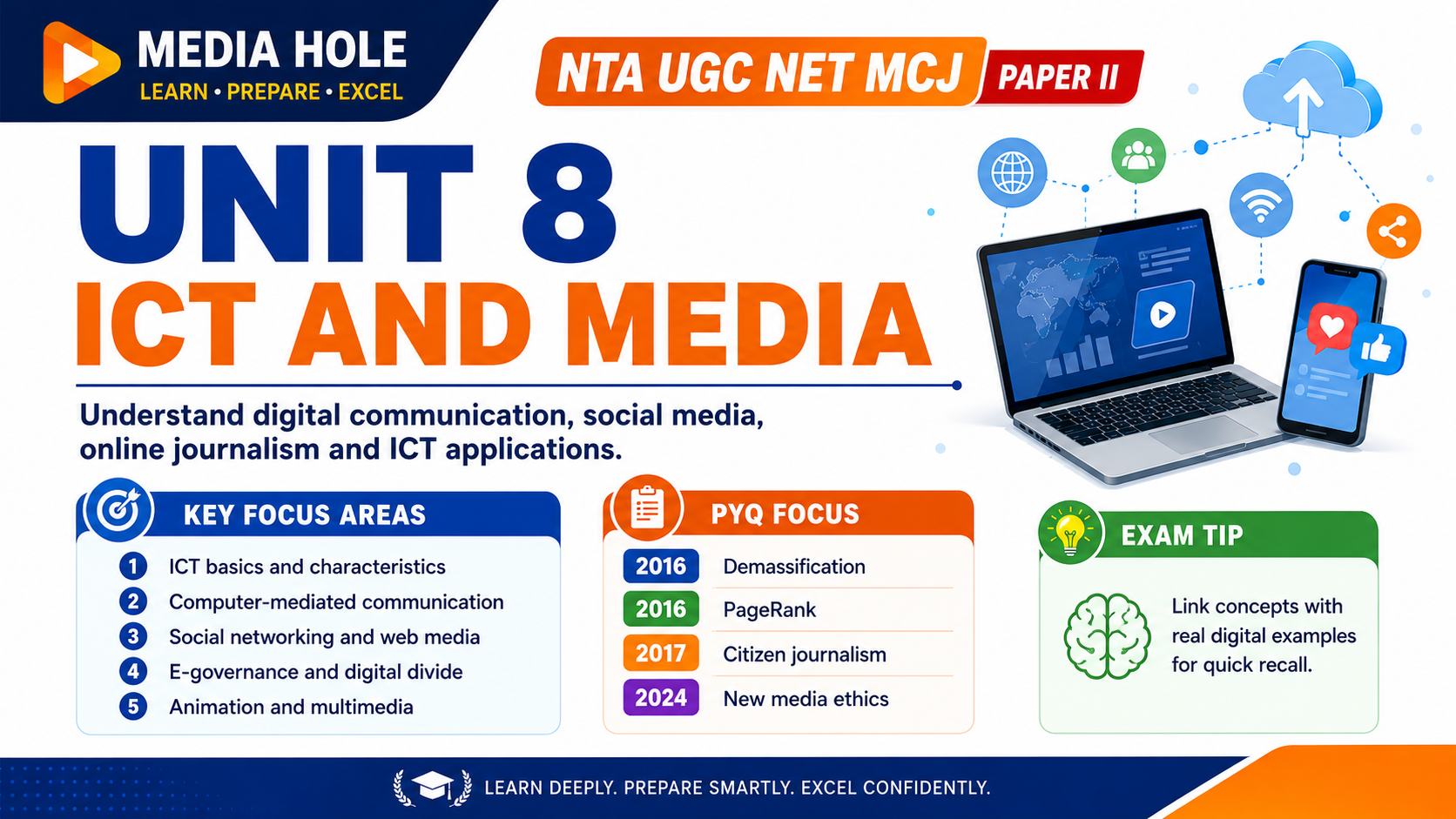
Unit 8 Complete Notes: ICT and Media
1. Unit 8 at a Glance
| Syllabus Area | What to Prepare | PYQ Importance |
|---|---|---|
| ICT and media | Definition, characteristics, role, computer-mediated communication, digitisation and impact on mass media. | Asked through concept and application-based questions. |
| Social networking | Social media, online communities, user-generated content, citizen journalism, blogs and microblogs. | Repeated in new media and journalism ethics questions. |
| Web-enabled media economy | Online advertising, SEO, PageRank, analytics, subscriptions, digital content economy and platform commerce. | Important PYQ area. |
| Mobile adaptation | Mobile journalism, apps, responsive design, push notifications, mobile video and new generation telephony. | Useful for current digital media questions. |
| ICT in education and development | E-learning, digital divide, online education, e-governance, public service delivery and development communication. | Conceptual and application-based questions. |
| Animation | Animation concepts, techniques, 2D, 3D, stop motion, keyframe, motion graphics and digital production. | Asked through direct technique and media production questions. |
2. Infographic Flow: ICT to Digital Media
3. Meaning of ICT
ICT means Information and Communication Technology. It includes technologies used to create, store, process, transmit, retrieve and exchange information. In media studies, ICT includes computers, internet, mobile phones, digital networks, software, social media platforms, online publishing tools and multimedia systems.
| ICT Element | Media Use |
|---|---|
| Computer | Writing, editing, designing, data analysis and digital production. |
| Internet | Publishing, distribution, search, networking and audience interaction. |
| Mobile phone | News gathering, shooting, editing, live reporting and audience access. |
| Software | Editing, design, animation, content management and analytics. |
| Digital networks | Transmission, collaboration, cloud storage and online communities. |
4. Characteristics of ICT-based Media
| Characteristic | Meaning | Example |
|---|---|---|
| Digitisation | Conversion of text, image, audio and video into digital form. | Digital newspaper, online video, podcast. |
| Interactivity | Audience can respond, comment, share and participate. | Comments, polls, likes, shares. |
| Convergence | Print, audio, video and data come together on digital platforms. | News website with text, video, podcast and infographic. |
| Multimedia | Combination of text, image, audio, video and graphics. | Interactive story package. |
| Hypertextuality | Information connected through links. | Hyperlinks in online news reports. |
| Immediacy | Fast publishing and real-time updates. | Live blog, breaking news alert. |
| Personalisation | Content customised for user interest and behaviour. | Recommendation feed, personalised notification. |
5. Computer-Mediated Communication
Computer-mediated communication means communication that occurs through computers or digital devices. It includes email, chat, video conferencing, social media, online forums, blogs, messaging apps and collaborative platforms.
| CMC Type | Meaning | Example |
|---|---|---|
| Synchronous CMC | Communication happens in real time. | Live chat, video call, webinar. |
| Asynchronous CMC | Communication does not require both users to be online at the same time. | Email, discussion forum, comment thread. |
| One-to-one | Communication between two people. | Email or direct message. |
| One-to-many | One source communicates to many users. | Newsletter, blog post, online lecture. |
| Many-to-many | Many users communicate with each other. | Social networking group, online forum. |
6. Impact of ICT on Mass Media
| Before ICT | After ICT |
|---|---|
| One-way communication. | Interactive communication. |
| Fixed publication/broadcast schedule. | Continuous updates and 24x7 publishing. |
| Audience mainly receives content. | Audience creates, shares and comments on content. |
| Separate media platforms. | Converged platforms combining text, audio, video and data. |
| Limited feedback. | Instant feedback, analytics and engagement metrics. |
| Gatekeeping by media organisations. | Algorithmic gatekeeping and platform-driven visibility. |
7. Digitisation
Digitisation is the conversion of information into digital form. It allows media content to be stored, copied, edited, transmitted and distributed using computers and networks.
| Digitised Content | Example |
|---|---|
| Text | Online article, e-book, PDF. |
| Audio | Podcast, digital radio, music streaming. |
| Video | OTT, YouTube, digital news video. |
| Image | Digital photograph, infographic, meme. |
| Data | Interactive chart, election dashboard, data story. |
8. Internet and World Wide Web
The internet is a global network of connected computer networks. The World Wide Web is a system of linked documents, websites and resources accessed through the internet using browsers.
| Term | Meaning |
|---|---|
| Internet | Global network infrastructure. |
| World Wide Web | Linked information system accessed through the internet. |
| Website | Collection of web pages under a domain. |
| Web page | Single page of web content. |
| URL | Address of a web resource. |
| Browser | Software used to access web pages. |
| Search engine | Tool for finding web information. |
9. Online Journalism
Online journalism is journalism produced and distributed through digital platforms such as websites, apps, blogs, social media, newsletters and multimedia platforms.
| Online Journalism Feature | Meaning |
|---|---|
| Real-time update | Stories can be updated continuously. |
| Hyperlinks | Readers can access related sources and background. |
| Multimedia | Text, photo, audio, video and graphics can be combined. |
| Interactivity | Audience can comment, share and participate. |
| Personalisation | Content can be customised using user data and algorithms. |
| Analytics | Audience behaviour can be measured through clicks, time spent and engagement. |
10. Social Networking and Social Media
Social networking platforms allow users to create profiles, build networks, share content and interact with others. Social media has changed news distribution, public opinion formation, activism, marketing and political communication.
| Social Media Element | Meaning / Use |
|---|---|
| Profile | User identity on a platform. |
| Feed | Stream of posts selected by platform design and algorithms. |
| Hashtag | Keyword label used to organise posts and trends. |
| Viral content | Content that spreads rapidly through sharing. |
| Algorithm | System that ranks, recommends or filters content. |
| Influencer | User with strong audience influence on digital platforms. |
| Community | Network of users around shared interest or identity. |
11. Blogs, Citizen Journalism and User-generated Content
Blogs and social media enabled ordinary users to publish views, reports, images and videos. Citizen journalism refers to news-related content created by non-professional citizens, especially during events, crises and public issues.
| Concept | Meaning |
|---|---|
| Blog | Regular online publication usually arranged in reverse chronological order. |
| Microblog | Short-form posting platform. |
| Citizen journalism | News reporting by ordinary citizens, often using digital tools. |
| User-generated content | Content created and shared by users rather than professional media organisations. |
| Participatory media | Media environment where audiences participate in content creation and circulation. |
12. Economics and Commerce of Web-enabled Media
Web-enabled media changed the business model of media through digital advertising, subscriptions, paywalls, membership, sponsored content, platform monetisation, analytics and e-commerce integration.
| Revenue / Commerce Model | Meaning |
|---|---|
| Display advertising | Banner or visual ad on website/app. |
| Search advertising | Ads linked with search queries. |
| Native advertising | Paid content designed to match platform style. |
| Subscription / paywall | User pays for access to content. |
| Membership | Audience supports a media platform through recurring contribution. |
| Affiliate revenue | Commission earned from purchases through referral links. |
| Data-driven advertising | Ads targeted using user behaviour and audience data. |
13. SEO, PageRank and Digital Visibility
Search Engine Optimisation helps online content become visible in search results. PageRank is associated with Google’s system for ranking pages based on importance and links.
| Term | Meaning |
|---|---|
| SEO | Optimising content and website structure for better search visibility. |
| Keyword | Search term used by users. |
| Backlink | Link from another website to your page. |
| PageRank | Google-linked system for determining page importance. |
| CPC | Cost per click. |
| CPM | Cost per thousand impressions. |
14. Mobile Adaptation and New Generation Telephony
Mobile adaptation means designing media content for mobile screens, mobile behaviour and mobile networks. New generation telephony includes smartphones, mobile internet, apps, messaging platforms, video calling and mobile-first services.
| Mobile Media Feature | Meaning |
|---|---|
| Responsive design | Content adjusts to different screen sizes. |
| Mobile journalism | Reporting, shooting, editing and publishing using mobile phones. |
| Push notification | Alert sent to user’s device. |
| Short-form video | Mobile-friendly video format for quick consumption. |
| Location-based service | Content or service based on user location. |
| App-based publishing | News and media content delivered through mobile apps. |
15. New Media Ethics
New media ethics deals with verification, privacy, transparency, copyright, hate speech, trolling, deepfakes, digital manipulation, algorithmic bias, user-generated content and online accountability.
| Ethical Issue | Responsible Practice |
|---|---|
| Fake news | Verify source, date, image, video and context. |
| User-generated content | Check permission, authenticity and safety before publication. |
| Privacy | Do not expose personal data without public-interest justification. |
| Deepfake | Use forensic verification and label manipulated content. |
| Algorithmic bias | Recognise how algorithms may privilege or suppress content. |
| Online correction | Correct digital errors quickly and transparently. |
16. ICT in Education
ICT supports education through online classes, learning management systems, digital libraries, educational apps, recorded lectures, video conferencing, MOOCs, virtual classrooms and open educational resources.
| ICT Tool | Educational Use |
|---|---|
| LMS | Learning Management System for course delivery and assessment. |
| MOOC | Massive Open Online Course. |
| Video conferencing | Live online teaching and meetings. |
| Digital library | Online access to books, journals and resources. |
| Smart classroom | Use of digital boards, projectors and connected learning tools. |
| OER | Open Educational Resources. |
17. ICT for Development and E-governance
ICT is used in development for public service delivery, health communication, agriculture, disaster management, education, financial inclusion, transparency and citizen participation. E-governance uses digital platforms to deliver government services and information.
| ICT Application | Development Use |
|---|---|
| E-governance | Digital delivery of public services and information. |
| Digital identity | Access to services, verification and welfare delivery. |
| E-health | Telemedicine, health alerts and digital health records. |
| E-agriculture | Weather, market price, farming advice and extension communication. |
| Digital payments | Financial inclusion and cashless services. |
| Citizen feedback | Online grievance redressal and public participation. |
18. Digital Divide
Digital divide refers to unequal access to ICT and digital skills. It may be based on income, gender, region, language, disability, education and infrastructure.
| Digital Divide Type | Example |
|---|---|
| Access divide | No device, poor internet, lack of electricity. |
| Skill divide | Unable to use digital tools effectively. |
| Language divide | Digital content unavailable in local languages. |
| Usage divide | People use ICT differently based on social and economic conditions. |
| Gender divide | Unequal access to devices and digital literacy for women and girls. |
19. Digital Tools for Media Storytelling
| Digital Product | Common Tool / Use |
|---|---|
| Map | CartoDB / mapping tools for location-based stories. |
| Infographics | Infogram / visual data presentation. |
| Digital stories | Movie Maker / video storytelling tools. |
| Timeline | Dipity / Tiki-Toki style timeline tools. |
20. Podcasting, Video Podcasting and Peer-to-peer Networks
Podcasting distributes audio content through digital platforms. Video podcasting adds visual content. Peer-to-peer networking allows users’ devices to share resources directly with one another.
| Term | Meaning |
|---|---|
| Podcast | Digital audio programme distributed online. |
| Video podcast | Podcast-like episodic content with video. |
| Streaming | Playing media online without downloading the full file first. |
| Peer-to-peer network | Network where users share directly with each other. |
| RSS | Feed technology useful for syndicating updates. |
21. Animation: Concepts and Techniques
Animation creates the illusion of movement by displaying a sequence of images or frames. It is used in cinema, television, advertising, education, news graphics, explainer videos, games and digital media.
| Animation Technique | Meaning |
|---|---|
| Traditional animation | Frame-by-frame hand-drawn animation. |
| 2D animation | Flat two-dimensional animation. |
| 3D animation | Computer-generated animation with three-dimensional models. |
| Stop motion | Physical objects moved frame by frame. |
| Keyframe animation | Important frames are set and software fills the motion between them. |
| Motion graphics | Animated text, shapes, icons and visual information. |
| CGI | Computer-generated imagery. |
22. PYQ Mapping Table
| PYQ Source | Question Area | What to Revise |
|---|---|---|
| September 2016 Paper III | Alvin Toffler and ICT impact | Demassification. |
| September 2016 Paper III | Google and digital visibility | PageRank system used to determine page importance. |
| September 2016 Paper III | Digital storytelling tools | Map-CartoDB, Infographic-Infogram, digital stories-Movie Maker, timeline-Dipity/Tiki-Toki. |
| September 2016 Paper III | Bloggers and citizen journalists | Truth, objectivity and interactive media ethics. |
| November 2017 Paper III | Video podcasting and peer-to-peer networking | New architecture of digital media/aesthetics assertion-reason area. |
| November 2017 Paper III | Content management | Movie industry and control/protection of digital content. |
| November 2017 Paper III | Digital storage | Electronic flash memory data storage device: flash card. |
| November 2017 Paper III | Citizen journalism chronology | Emergence of citizen journalism with other journalism types. |
| September 2013 Paper II | Nicholas Negroponte and WWW | World Wide Web as an engine of public relations. |
| September 2013 Paper II | Media literacy and convergence | Interaction with media contents and critical analysis = media literacy. |
| September 2013 Paper III | Interactivity passage | Interactivity and choice are not universal benefits; users need prior knowledge and effort. |
| January 2017 Paper III | Digital editing and storage | Timeline, digital storage devices and digital media production terms. |
| January 2017 Paper III | Online advertising | Banner, CPM, SEO and CPC as online advertisement methods. |
23. Frequently Repeated PYQ Areas
24. Quick Revision Sheet
| Term | One-line Revision |
|---|---|
| ICT | Technology used to create, store, process and communicate information. |
| CMC | Computer-mediated communication through digital devices. |
| Digitisation | Conversion of information into digital form. |
| Interactivity | Audience can respond, share and participate. |
| Convergence | Integration of text, audio, video, graphics and data. |
| Demassification | Fragmentation of mass audiences into specialised groups. |
| PageRank | Google-linked system for determining page importance. |
| SEO | Search Engine Optimisation. |
| Citizen journalism | News-related reporting by ordinary citizens. |
| Digital divide | Unequal access to ICT and digital skills. |
| E-governance | Use of ICT for public services and governance. |
| Animation | Creating illusion of motion through sequential images/frames. |
25. Practice Questions with PYQ Angle
Answer: Demassification.
PYQ Angle: September 2016 Paper III.
Answer: PageRank.
PYQ Angle: September 2016 Paper III.
Answer: News reporting or news-related content created by ordinary citizens using media tools.
PYQ Angle: November 2017 Paper III.
Answer: Inequality in access to ICT, internet, digital devices and digital skills.
PYQ Angle: ICT and development application area.
Answer: Use of ICT to deliver government services, information and citizen interaction.
PYQ Angle: ICT in development and governance area.
Answer: Creation of illusion of movement by showing a sequence of frames/images.
PYQ Angle: Animation concepts and techniques.
Answer: CartoDB for maps, Infogram for infographics and Dipity/Tiki-Toki for timelines.
PYQ Angle: September 2016 Paper III.
26. Final Exam Tip
For Unit 8, revise through five tables: ICT characteristics, online journalism and social media, SEO/web economy terms, ICT for education and development, and animation techniques. PYQs usually test this unit through digital terms, matching questions, assertion-reason, tools, internet concepts and new media ethics.