
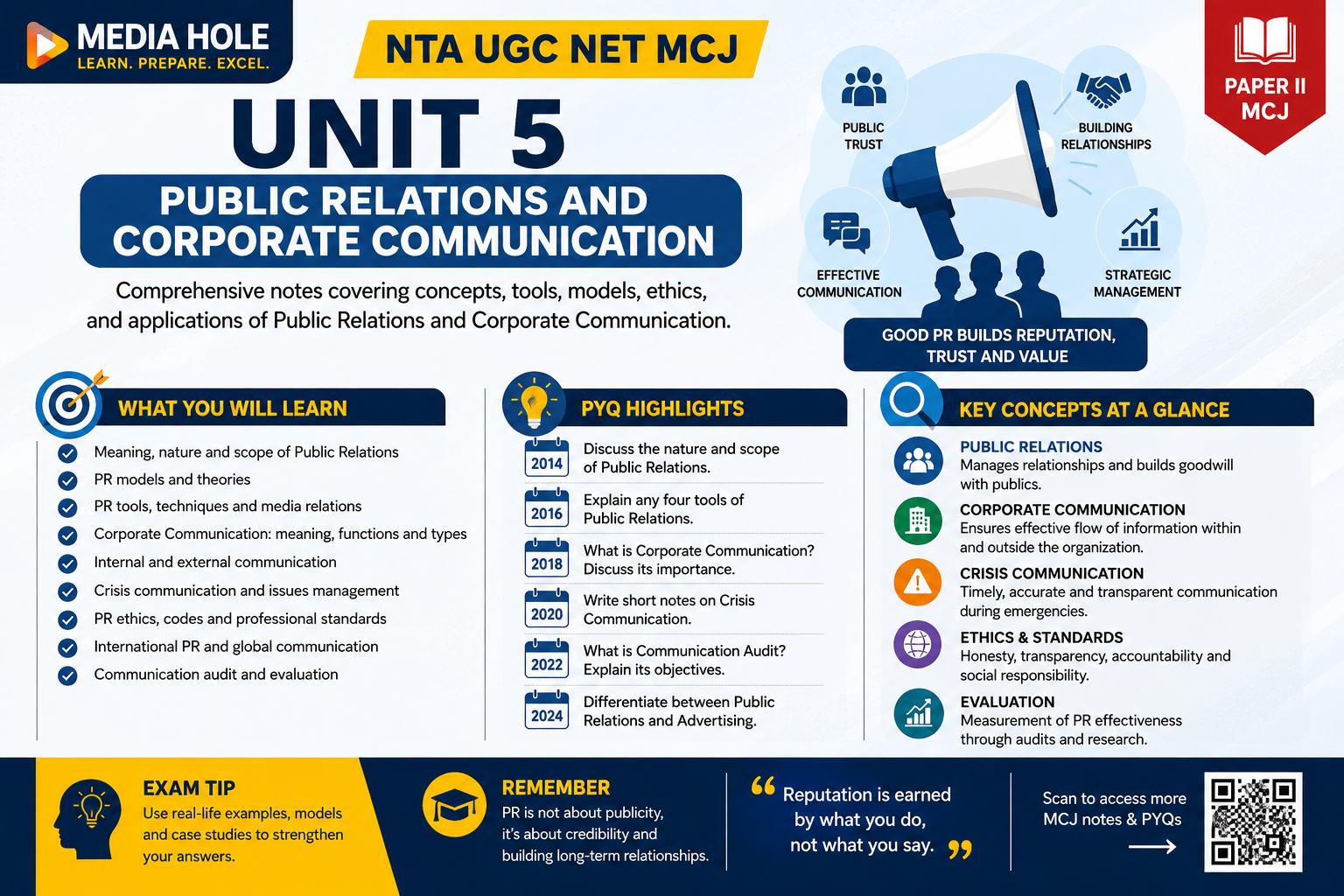
Unit 5 Complete Notes: Public Relations and Corporate Communication
1. Unit 5 at a Glance
| Syllabus Area | What to Prepare | PYQ Importance |
|---|---|---|
| PR and corporate communication | Definition, concept, scope, public opinion, reputation, goodwill and relationship management. | Direct concept and matching questions. |
| Structure of PR | PR in government, public sector, private sector and non-government sectors. | Application-based and sector-specific questions. |
| Tools and techniques | Press release, press conference, house journal, newsletter, clipsheet, events, publicity and media relations. | Repeated PYQ area. |
| Corporate communication | Corporate image, identity, reputation, stakeholder communication, CSR and internal communication. | Conceptual and practical question area. |
| Crisis communication | Crisis planning, crisis response, spokesperson, media handling and image recovery. | Important for assertion-reason and applied questions. |
| PR ethics | Code of Athens, transparency, truth, fairness, public interest and professional responsibility. | PYQs on Code of Athens and PR professional ethics. |
| International PR and audit | Public diplomacy, international PR, communication audit and PR evaluation. | Passage and direct factual questions. |
2. Infographic Flow: Public Relations Process
3. Meaning and Definition of Public Relations
Public relations is a planned and sustained communication process used by an organisation to create mutual understanding, goodwill, trust and positive relationships with its publics. It deals with reputation, public opinion, stakeholder engagement and organisational image.
| PR Feature | Meaning |
|---|---|
| Planned communication | PR is not accidental; it is strategically planned. |
| Mutual understanding | PR attempts to build understanding between organisation and publics. |
| Goodwill | PR builds positive attitude and trust. |
| Public opinion | PR monitors and responds to how publics think and feel. |
| Relationship management | Modern PR focuses on long-term relationships with stakeholders. |
4. Public Relations vs Publicity vs Propaganda vs Advertising
| Concept | Meaning | Key Difference |
|---|---|---|
| Public Relations | Strategic relationship-building with publics. | Long-term, two-way, reputation-oriented. |
| Publicity | Getting public/media attention for a person, issue or organisation. | Often media visibility-focused; may be unpaid. |
| Advertising | Paid persuasive communication by an identified sponsor. | Paid space/time; controlled message. |
| Propaganda | One-sided persuasive communication intended to shape beliefs or action. | May use manipulation or selective information. |
| Corporate communication | Integrated communication of an organisation with internal and external stakeholders. | Broader organisational communication and reputation management. |
5. Evolution of Public Relations
Public relations evolved from press agentry and publicity into a professional function involving research, stakeholder relations, corporate reputation, two-way communication and strategic management.
| Stage | Key Idea |
|---|---|
| Press agentry | Publicity-seeking, event promotion and media attention. |
| Public information | Providing accurate information to the public and media. |
| Two-way asymmetric | Uses research for persuasion, often in favour of the organisation. |
| Two-way symmetric | Balanced dialogue and mutual understanding between organisation and publics. |
| Strategic PR | PR as a management function linked with reputation and stakeholder relationships. |
6. Major PR Scholars and Contributors
| Scholar / Figure | Contribution | Exam Use |
|---|---|---|
| Ivy Lee | Known for early public information approach and declaration of principles. | Often linked with truthful information and modern PR beginnings. |
| Edward Bernays | Associated with public opinion, persuasion and engineering of consent. | Important PR history name. |
| Grunig and Hunt | Four models of public relations. | Press agentry, public information, two-way asymmetric and two-way symmetric models. |
| Cutlip, Center and Broom | PR process and management approach. | Research-listening and PR process questions. |
| Lang and Lang | Public opinion formation model. | Asked in public opinion context. |
| Sam Black | PR and corporate communication-related writing. | Useful as a PR author reference. |
7. Four Models of Public Relations
| Model | Nature | Purpose |
|---|---|---|
| Press Agentry / Publicity | One-way, publicity-focused. | Attention and promotion. |
| Public Information | One-way, information-focused. | Dissemination of truthful information. |
| Two-way Asymmetric | Two-way but imbalanced. | Scientific persuasion and attitude change for organisation benefit. |
| Two-way Symmetric | Two-way and balanced. | Mutual understanding and negotiation. |
8. Publics and Stakeholders
In PR, publics are groups of people who affect or are affected by an organisation. Stakeholders are individuals or groups with interest, influence or stake in the organisation.
| Public / Stakeholder | Communication Need |
|---|---|
| Employees | Internal communication, motivation, trust and organisational culture. |
| Customers | Product/service information, feedback, trust and relationship. |
| Media | Press releases, briefings, interviews and verified information. |
| Government | Policy communication, compliance and public affairs. |
| Investors | Financial communication, performance and corporate transparency. |
| Community | CSR, local issues, environment and public goodwill. |
| NGOs / civil society | Advocacy, collaboration, social issues and accountability. |
9. Structure of PR in Different Sectors
| Sector | PR Structure / Focus | Example Work |
|---|---|---|
| Government PR | Public information, development campaigns, welfare schemes and crisis communication. | Health campaigns, disaster alerts, policy announcements. |
| Public sector PR | Public accountability, service image, stakeholder communication and community relations. | PSU image building and citizen communication. |
| Private sector PR | Brand reputation, corporate image, investor relations, media relations and crisis response. | Product recall, corporate launch, brand reputation campaign. |
| NGO PR | Advocacy, fundraising, community mobilisation and social campaign communication. | Rights campaign, awareness drive, donor communication. |
| International PR | Communication across cultures, nations, institutions and global publics. | Public diplomacy, global campaigns, international organisation communication. |
10. Tools and Techniques of PR
| Tool / Technique | Use |
|---|---|
| Press release | Written information sent to media for possible publication. |
| Press conference | Formal media meeting to announce or explain important information. |
| Press briefing | Short and focused information session for journalists. |
| Media kit | Package of background information, release, photos, factsheets and contact details. |
| House journal | Organisation publication for employees or stakeholders. |
| Newsletter | Periodic update for internal or external publics. |
| Clipsheet | Collection of publicity stories or media coverage clips. |
| Event | Launch, exhibition, seminar, CSR event or stakeholder meeting. |
| Website and social media | Direct communication, updates, engagement and crisis response. |
| Lobbying | Persuasive communication with policy makers or decision makers. |
11. Media Relations
Media relations is the PR function that builds and maintains professional relationships with journalists, editors and media organisations. It helps ensure accurate, timely and credible communication.
| Good Media Relations | Poor Media Relations |
|---|---|
| Provides accurate and timely information. | Hides or manipulates important facts. |
| Respects journalists’ deadlines. | Sends irrelevant or vague material. |
| Gives access to authorised spokespersons. | Uses evasive or contradictory responses. |
| Maintains trust before, during and after crisis. | Responds only when negative coverage appears. |
12. Corporate Communication
Corporate communication is the integrated management of all internal and external communication of an organisation. It builds corporate image, identity, reputation and stakeholder trust.
| Corporate Communication Area | Meaning |
|---|---|
| Corporate identity | How the organisation presents itself through name, logo, design, behaviour and communication. |
| Corporate image | How publics perceive the organisation. |
| Corporate reputation | Long-term evaluation of organisational credibility and trust. |
| Internal communication | Communication with employees and internal publics. |
| External communication | Communication with customers, media, government, investors and society. |
| CSR communication | Communication about social responsibility and community engagement. |
13. Corporate Social Responsibility and PR
CSR communication explains an organisation’s social, environmental and community responsibility. Good CSR communication should be truthful, transparent and connected to real action rather than image-only publicity.
14. Crisis Communication
Crisis communication is the communication used before, during and after a crisis to protect life, reduce confusion, maintain trust and restore organisational reputation.
| Crisis Stage | Communication Task |
|---|---|
| Pre-crisis | Risk assessment, crisis team, spokesperson training and message templates. |
| During crisis | Fast, accurate and empathetic communication. |
| Media response | Briefings, statements, fact sheets and regular updates. |
| Stakeholder response | Communication with employees, customers, regulators and community. |
| Post-crisis | Evaluation, corrective action, apology if needed and reputation rebuilding. |
15. Crisis Communication Principles
| Principle | Meaning |
|---|---|
| Be quick | Delay creates rumours and distrust. |
| Be accurate | Wrong information worsens the crisis. |
| Be consistent | All spokespersons should communicate the same facts. |
| Be empathetic | Show concern for affected people. |
| Be transparent | Acknowledge what is known, unknown and being done. |
| Take corrective action | Communication must be supported by real action. |
16. Ethics of Public Relations
PR ethics deals with truthful communication, transparency, fairness, public interest, respect for media independence and avoidance of manipulation.
| Ethical Principle | Meaning |
|---|---|
| Truthfulness | Do not knowingly spread false information. |
| Transparency | Disclose identity, intent and organisational interest. |
| Public interest | Balance organisational interest with social responsibility. |
| Confidentiality | Protect confidential information responsibly. |
| Accountability | Accept responsibility for communication consequences. |
| Respect for media | Avoid bribery, paid news and manipulation of journalists. |
17. International Public Relations and Public Diplomacy
International public relations deals with communication across national, cultural and political boundaries. It includes public diplomacy, global corporate reputation, international campaigns and intercultural stakeholder communication.
| Concept | Meaning |
|---|---|
| International PR | PR across countries and cultures. |
| Public diplomacy | Communication by governments or states to influence foreign publics. |
| Nation branding | Managing a country’s image in the global arena. |
| Intercultural communication | Communication across different cultural backgrounds. |
| Global reputation | How an organisation or country is perceived internationally. |
18. Communication Audit
Communication audit is a systematic evaluation of an organisation’s communication system, channels, messages, image and effectiveness. It helps identify communication gaps and improve strategy.
| Audit Area | What It Checks |
|---|---|
| Internal communication | Employee communication, channels, feedback and organisational climate. |
| External communication | Media relations, public communication, customer communication and stakeholder response. |
| Corporate image | Public perception of the organisation. |
| Message consistency | Whether communication is clear and aligned. |
| Channel effectiveness | Whether selected media/channels reach target publics. |
19. PR Evaluation
| Evaluation Level | Example Indicator |
|---|---|
| Output | Press releases sent, events held, posts published. |
| Outtake | Audience awareness, understanding and recall. |
| Outcome | Attitude change, behaviour change, improved relationship. |
| Impact | Long-term reputation, trust and organisational performance. |
| Media monitoring | Coverage quantity, tone, reach and message accuracy. |
20. PR Organisations, Awards and Codes
| Term | Exam Use |
|---|---|
| PRSI | Public Relations Society of India. |
| PRCI | Public Relations Council of India; linked with Chanakya Awards in PYQ. |
| PRSA | Public Relations Society of America. |
| IPRA | International Public Relations Association. |
| Code of Athens | International PR ethics code adopted in Athens in 1965. |
| World Assembly of PR Associations | First World Assembly linked with Mexico City in PYQ. |
| FleishmanHillard | International public relations agency. |
21. PYQ Mapping Table
| PYQ Source | Question Area | What to Revise |
|---|---|---|
| June 2012 Paper III | Two-way asymmetric PR model | Main purpose: scientific persuasion. |
| June 2012 Paper III | CSR | “Enlightened self-interest” as the notion behind corporate social responsibility. |
| June 2013 Paper III | Evolution of PR | Public relations profession evolved from press agentry. |
| June 2013 Paper III | PR awards and ethics | Chanakya Awards and Code of Athens source. |
| December 2010 Paper II | International PR ethics | Code of ethics for PR adopted at Athens conference in 1965. |
| December 2013 Paper III | Code of Athens | PR profession and practical limitations of ethical codes. |
| December 2012 Paper III | Crisis management | Identification and analysis of situation/problem and offering solution. |
| December 2012 Paper III | Corporate PR | Corporate public relations deals with the whole organisation. |
| December 2014 Paper III | Communication audit | Studies used to measure a company’s position. |
| June 2014 Paper III | Public diplomacy | CNN effect, humanitarian crisis and state rebranding in global politics. |
| November 2017 Paper III | PR and marketing | Public Relations and Advertising associated with marketing in commercial world. |
| November 2017 Paper III | World PR associations | First World Assembly of Public Relations Associations held in Mexico City. |
| September 2016 Paper III | PR agency and clipsheet | FleishmanHillard as PR agency; clipsheet contains publicity stories. |
| September 2016 Paper III | Propaganda | Black propaganda credited to a false source. |
| July 2018 Paper II | PR process | Cutlip, Center and Broom PR process sequence beginning with research-listening. |
| September 2013 Paper II | Digital PR / online publics | World Wide Web as an engine of public relations; third sector reaching publics using media. |
22. Frequently Repeated PYQ Areas
23. Quick Revision Sheet
| Term | One-line Revision |
|---|---|
| Public Relations | Planned communication for mutual understanding, goodwill and reputation. |
| Corporate Communication | Integrated organisational communication with internal and external stakeholders. |
| Publics | Groups that affect or are affected by an organisation. |
| Stakeholders | People or groups with interest or stake in the organisation. |
| Press Agentry | Early publicity-oriented form of PR. |
| Two-way Asymmetric | Scientific persuasion. |
| Two-way Symmetric | Balanced mutual understanding. |
| Clipsheet | Contains publicity stories or media clippings. |
| CSR | Corporate social responsibility; linked with enlightened self-interest. |
| Crisis Communication | Communication used to manage crisis and protect reputation. |
| Communication Audit | Study to assess communication and company position. |
| Public Diplomacy | Communication by states/governments with foreign publics. |
| Code of Athens | International PR ethics code linked with Athens, 1965. |
24. Practice Questions with PYQ Angle
Answer: Scientific persuasion.
PYQ Angle: June 2012 Paper III.
Answer: Press agentry.
PYQ Angle: June 2013 Paper III.
Answer: The whole organisation.
PYQ Angle: December 2012 Paper III.
Answer: Publicity stories.
PYQ Angle: September 2016 Paper III.
Answer: Corporate social responsibility.
PYQ Angle: June 2012 Paper III.
Answer: Athens.
PYQ Angle: December 2010 Paper II.
Answer: A study used to measure a company’s communication position and effectiveness.
PYQ Angle: December 2014 Paper III.
Answer: Public Relations.
PYQ Angle: September 2016 Paper III.
25. Final Exam Tip
For Unit 5, revise through five tables: PR models, PR tools, corporate communication concepts, ethics/codes and PYQ mapping. Most questions from this unit test terms, models, PR organisations, corporate image, crisis management and ethical codes.