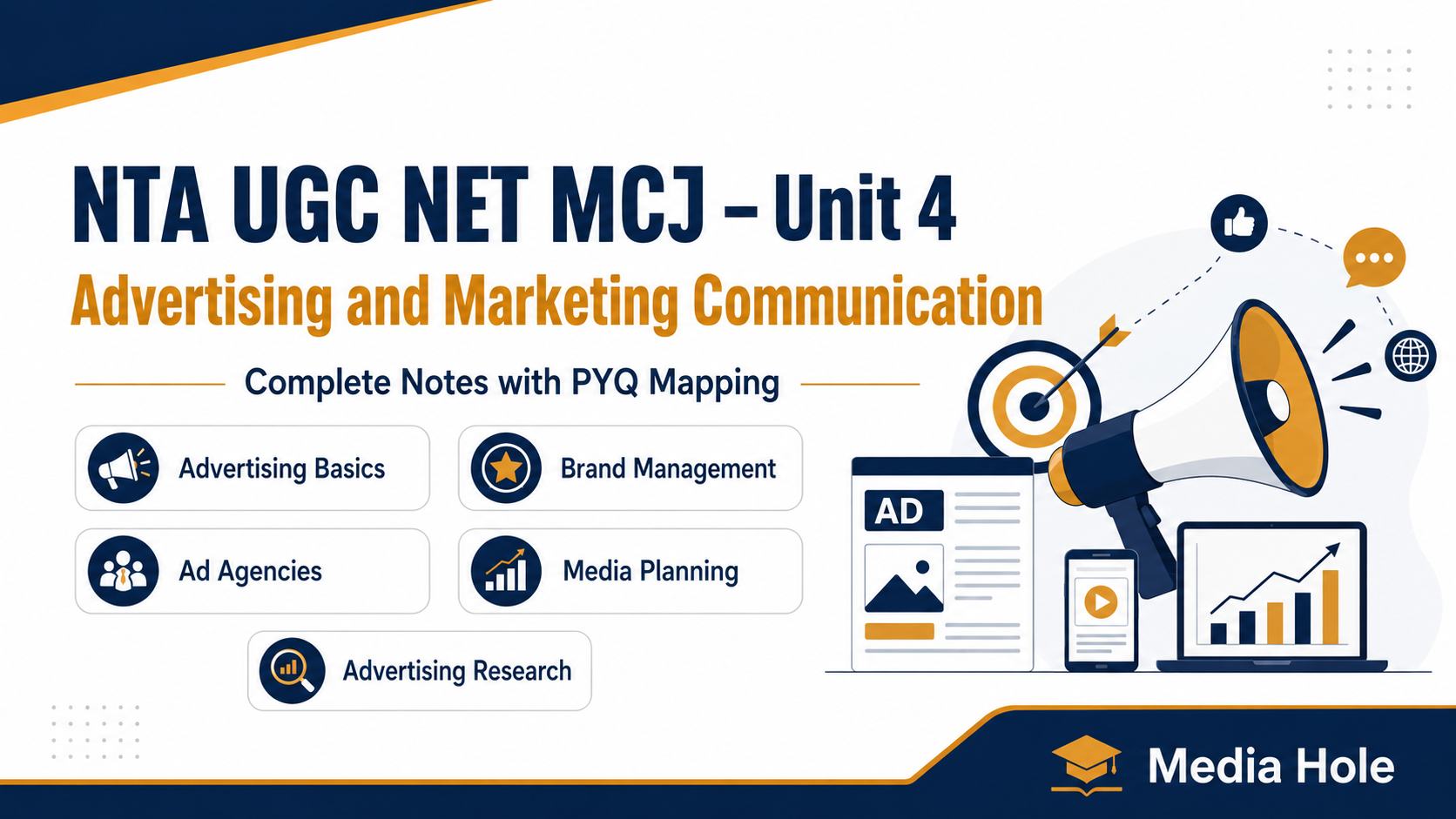
Unit 4 Complete Notes: Advertising and Marketing Communication
1. Unit 4 at a Glance
| Syllabus Area | What to Prepare | PYQ Importance |
|---|---|---|
| Advertising basics | Definition, concept, functions, types and evolution of advertising. | Direct factual and concept-based PYQs. |
| Ethics and standards | Advertising ethics, misleading ads, puffery, surrogate advertising, social responsibility and regulatory standards. | Asked through application and assertion-reason formats. |
| Theories and models | AIDA, DAGMAR, hierarchy of effects, advertising spiral, Gestalt and brand image. | Repeated question area. |
| Brand management | Brand, brand image, brand identity, brand positioning, brand equity and USP. | Scholar-concept and direct term questions. |
| Advertising agency | Agency structure, functions, client-agency relationship, campaign brief and mandatories. | Agency-identification and client-brief questions. |
| Media planning and budgeting | Reach, frequency, GRP, CPM, media mix, scheduling and advertising budget. | Very important for PYQs. |
| Creative strategy and research | Copy, visuals, slogan, language, translation, pre-testing, post-testing and market research. | Asked through practical advertising terms. |
2. Infographic Flow: Advertising Campaign Process
3. Meaning and Definition of Advertising
Advertising is paid, non-personal and persuasive communication by an identified sponsor, usually carried through mass media or digital media, to inform, persuade or remind a target audience about a product, service, idea, brand or cause.
| Feature | Meaning |
|---|---|
| Paid form | The advertiser pays for media space, time or placement. |
| Non-personal | The message is not delivered face-to-face to one individual. |
| Identified sponsor | The source or brand behind the advertisement is known. |
| Persuasive | It attempts to influence awareness, attitude, preference or behaviour. |
| Mass / targeted reach | It may reach broad masses or a narrowly targeted audience. |
4. Functions of Advertising
| Function | Explanation | Example |
|---|---|---|
| Information | Creates awareness about products, services or ideas. | New product launch ad. |
| Persuasion | Influences people to prefer or purchase a brand. | Comparative or emotional ad. |
| Reminder | Keeps the brand in consumer memory. | Retentive advertising for established brands. |
| Brand building | Creates brand image, identity and personality. | Long-term corporate campaign. |
| Market expansion | Encourages wider use or new users. | New category education campaign. |
| Social awareness | Promotes socially relevant ideas or behaviour. | Health, voting, road safety or sanitation ad. |
5. Types of Advertising
| Type | Meaning | Example |
|---|---|---|
| Product advertising | Promotes a specific product. | Mobile phone advertisement. |
| Service advertising | Promotes a service. | Banking, insurance, education service ad. |
| Institutional advertising | Builds image of an organisation rather than one product. | Corporate reputation campaign. |
| Retail advertising | Promotes stores, offers and local sales. | Festival discount ad. |
| Classified advertising | Small text-based ad grouped by category. | Jobs, property, matrimonial, services. |
| Display advertising | Visual ad with design, headline, copy and images. | Newspaper display ad or banner ad. |
| Social advertising | Promotes public interest and socially relevant ideas. | Anti-tobacco, road safety, vaccination campaign. |
| National advertising | Large-scale advertising for products/services across a country. | National brand campaign. |
| Ambient advertising | Uses unusual existing spaces or public structures creatively. | Creative ad on stairs, bus stop, walls or public installation. |
| Direct mail advertising | Promotional message sent directly to selected consumers. | Email or postal mail campaign. |
6. Evolution of Advertising
| Stage | Characteristics |
|---|---|
| Early announcements | Town criers, signs, posters and marketplace announcements. |
| Print advertising | Newspapers and magazines became major advertising vehicles. |
| Industrial age advertising | Mass production created need for mass persuasion and brand differentiation. |
| Radio and television advertising | Sound, music, celebrity and audio-visual persuasion became powerful. |
| Integrated marketing communication | Advertising, PR, sales promotion and direct marketing began to work together. |
| Digital advertising | Search, social media, programmatic, mobile, influencer and data-driven advertising. |
7. Advertising Models and Theories
| Model / Theory | Key Idea | Exam Use |
|---|---|---|
| AIDA | Attention, Interest, Desire, Action. | Basic advertising response model. |
| DAGMAR | Defining Advertising Goals for Measured Advertising Results. | Advertising objective and measurement model. |
| Hierarchy of effects | Consumers move through awareness, knowledge, liking, preference, conviction and purchase. | Consumer response model. |
| Advertising spiral | Advertising moves through pioneering, competitive and retentive stages. | PYQ-linked model. |
| Gestalt theory | The whole is perceived as more than isolated parts; advertising design works through totality. | Direct factual PYQ area. |
| Brand image theory | Advertising creates a symbolic and psychological image of the brand. | Often linked with David Ogilvy. |
| USP | Unique Selling Proposition; a distinct product benefit used in advertising. | Creative strategy concept. |
8. Advertising Spiral
| Stage | Purpose |
|---|---|
| Pioneering | Introduces a new product category or new idea. |
| Competitive | Differentiates the brand from competitors. |
| Retentive | Maintains brand memory and loyalty. |
9. Brand Management
Brand management is the process of building, maintaining and strengthening a brand’s identity, image, positioning, equity and relationship with consumers.
| Brand Concept | Meaning |
|---|---|
| Brand | Name, symbol, design or identity that differentiates a product/service. |
| Brand image | Consumer perception of the brand. |
| Brand identity | How the brand wants to present itself. |
| Brand positioning | Place occupied by the brand in the consumer’s mind. |
| Brand equity | Value of a brand based on recognition, loyalty, perception and associations. |
| Brand personality | Human-like traits associated with a brand. |
10. Advertising Agency: Role, Structure and Function
An advertising agency is a professional organisation that plans, creates, produces, places and evaluates advertisements and campaigns for clients.
| Department / Role | Function |
|---|---|
| Account management | Handles client relationship and understands client needs. |
| Creative department | Creates copy, visuals, design, slogan, script and campaign idea. |
| Media planning | Selects media vehicles, schedule and budget allocation. |
| Research department | Studies consumer, market, competition and campaign effectiveness. |
| Production department | Produces print, audio, video and digital materials. |
| Digital / social team | Handles online campaigns, content, analytics and performance marketing. |
11. Client-Agency Relationship and Advertising Brief
The client-agency relationship is based on clear communication, mutual trust, strategy, creativity, deadlines and measurable objectives. The advertising brief gives the agency the necessary direction for campaign planning.
| Brief Element | Meaning |
|---|---|
| Objective | What the campaign should achieve. |
| Target audience | The specific audience to be reached. |
| Consumer insight | Important understanding about consumer behaviour or motivation. |
| Key message | Main idea the campaign must communicate. |
| Mandatories | Specific requirements that must be included in the advertisement. |
| Budget and timeline | Money and schedule constraints. |
12. Media Planning and Budgeting
Media planning decides where, when and how often advertisements should appear. It involves media selection, scheduling, budgeting, reach, frequency, GRP and cost efficiency.
| Media Planning Term | Meaning |
|---|---|
| Reach | Number or percentage of people exposed to the advertisement at least once. |
| Frequency | Average number of times the audience is exposed to the message. |
| GRP | Gross Rating Points; a measure of total advertising weight. |
| CPM | Cost per thousand impressions. |
| Media mix | Combination of media channels used in a campaign. |
| Scheduling | Timing and pattern of advertisement release. |
| Fringe time | TV time that precedes or follows prime time. |
| Space selling | Selling print space and broadcast time units for advertising. |
13. Advertising Budgeting
| Budgeting Method | Meaning |
|---|---|
| Affordable method | Advertiser spends what it can afford. |
| Percentage of sales | Budget is fixed as a percentage of sales. |
| Competitive parity | Budget is based on competitor spending. |
| Objective and task method | Budget is based on campaign objectives and required tasks. |
| Media-based budgeting | Budget depends on media cost, reach and frequency requirement. |
14. Advertising Creativity, Copy and Visuals
Advertising creativity is the ability to present a persuasive message in a fresh, memorable and effective way. It combines strategy, language, visual design, emotional appeal and brand promise.
| Creative Element | Role |
|---|---|
| Headline | Attracts attention and presents the main idea. |
| Body copy | Explains product, service, benefit or argument. |
| Slogan / Tagline | Memorable phrase linked with the brand. |
| Visual | Image, illustration or design that carries meaning. |
| Layout | Arrangement of headline, copy, image and logo. |
| Call to action | Encourages the audience to buy, visit, register, call or respond. |
| POP display | Point-of-purchase display that promotes product at sales location. |
15. Language, Translation and Transcreation in Advertising
Advertising language must be clear, persuasive, memorable and audience-sensitive. Translation transfers meaning between languages, while transcreation creatively adapts the message for culture, emotion and market context.
| Language Device | Use in Advertising |
|---|---|
| Slogan | Creates recall and brand identity. |
| Rhyme and rhythm | Makes the message memorable. |
| Pun | Uses wordplay for attention. |
| Metaphor | Creates symbolic meaning. |
| Local language | Improves cultural connection and relatability. |
| Transcreation | Adapts advertising idea for another language/culture without losing impact. |
16. Advertising Appeals
| Appeal | Meaning | Example |
|---|---|---|
| Rational appeal | Uses logic, features, price or performance. | Fuel efficiency, discount, durability. |
| Emotional appeal | Uses feelings and relationships. | Family, pride, love, nostalgia. |
| Fear appeal | Warns about risk or danger. | Health and road safety campaigns. |
| Humour appeal | Uses comedy to attract attention. | Funny TV commercial. |
| Celebrity appeal | Uses fame and credibility of a celebrity. | Actor endorsing a brand. |
| Slice-of-life appeal | Shows everyday life problem and solution. | Home, family or office problem solved by product. |
17. Advertising Campaign and Marketing
An advertising campaign is a planned series of messages with a common objective, theme and strategy. Marketing is broader than advertising and includes product, price, place and promotion.
| Marketing Element | Advertising Link |
|---|---|
| Product | Advertising highlights product features and benefits. |
| Price | Advertising may communicate affordability, premium value or offers. |
| Place | Advertising may guide consumers where to buy or access the service. |
| Promotion | Advertising works with sales promotion, PR, direct marketing and digital campaigns. |
18. Advertising and Marketing Research
Advertising and marketing research help advertisers understand consumers, test messages, measure campaign impact and improve strategy.
| Research Type | Use |
|---|---|
| Market research | Studies market size, competition and consumer behaviour. |
| Consumer research | Studies needs, attitudes, motivation and purchase behaviour. |
| Copy testing | Tests advertising copy before release. |
| Pre-testing | Tests advertisement before publication or broadcast. |
| Post-testing | Measures ad effectiveness after release. |
| Recall test | Measures how well people remember the ad. |
| Recognition test | Measures whether people recognise the ad when shown. |
| Cohort analysis | Studies groups with common characteristics over time; useful in advertising research. |
19. Standards and Ethics in Advertising
Advertising ethics means responsible, truthful, fair and non-deceptive persuasive communication. Advertisements should not mislead consumers, exploit vulnerable groups or promote harmful stereotypes.
| Ethical Issue | Responsible Practice |
|---|---|
| Misleading claims | Avoid false or exaggerated claims. |
| Puffery | Subjective exaggeration should not become deception. |
| Surrogate advertising | Avoid indirect promotion of restricted products. |
| Children in advertising | Avoid manipulation and unsafe behaviour. |
| Gender stereotypes | Avoid sexist, objectifying or discriminatory portrayals. |
| Controversial ads | Do not use controversy merely as a publicity stunt. |
| Consumer privacy | Respect data protection and consent in digital advertising. |
20. Digital Advertising
| Digital Format | Meaning |
|---|---|
| Banner advertising | Display ad placed on a website or app. |
| Search advertising | Ads shown with search engine results. |
| Social media advertising | Paid promotion on social platforms. |
| Native advertising | Ad designed to match platform content style. |
| Influencer marketing | Promotion through social media personalities or creators. |
| Programmatic advertising | Automated buying and placement of digital ads. |
| SEO / CPC / CPM | Digital visibility, cost-per-click and cost-per-thousand metrics. |
21. PYQ Mapping Table
| PYQ Source | Question Area | What to Revise |
|---|---|---|
| December 2006 Paper II | Social advertising | Social advertising relates to socially relevant ideas. |
| December 2006 Paper II | Space selling and puffery | Space/time selling in media; puffery as opinion statement about product/organisation. |
| December 2009 Paper II | Client brief and GRP | Mandatories; Gross Rating Points. |
| December 2009 Paper II | Media planning | Reach, cost and frequency as fundamental media planning factors. |
| June 2010 Paper II | Advertising theory and POP | Gestalt theory = totality; POP ad presentation = display stand. |
| December 2010 Paper II | Brand image | Brand image theory associated with David Ogilvy. |
| June 2011 Paper II | Advertising agency | Mudra Communication Ltd as advertising agency. |
| June 2012 Paper III | Advertising medium | Direct mail: high selectivity, immediacy and low cost. |
| December 2014 Paper III | Ambient advertising | Using existing public structures in advertising. |
| December 2014 Paper III | Pre-testing and pilot testing | Limitations of testing ads in artificial surroundings. |
| December 2013 Paper III | Response decay and scheme advertising | Decline in response to advertisements; promotion-linked scheme advertising. |
| June 2014 Paper III | CPM and Indian advertising industry | CPM in advertising and international character of Indian advertising agencies. |
| September 2016 Paper III | Direct marketing | Mail, telephone and non-personal contact tools used for specific customers. |
| November 2017 Paper III | Marketing and media planning | PR and advertising associated with marketing; fringe time; ABC digital measurement support. |
| January 2017 Paper III | Advertising research and online ads | Cohort analysis in advertising research; banner, CPM, SEO and CPC. |
| July 2018 Paper II | National advertising and advertising spiral | Product value in consumer mind; stages after introductory stage. |
| July 2018 Paper II | Advertising agency chronology | Chaitra Leo Burnett, Trikaya Grey, Mudra and FCB-Ulka sequence area. |
22. Frequently Repeated PYQ Areas
23. Quick Revision Sheet
| Term | One-line Revision |
|---|---|
| Advertising | Paid, non-personal persuasive communication by an identified sponsor. |
| Social advertising | Advertising of socially relevant ideas. |
| Space selling | Selling print space and broadcast time for advertising. |
| Puffery | Opinion-based exaggeration about a product or organisation. |
| Mandatories | Client’s specific requirements in an ad campaign. |
| GRP | Gross Rating Points. |
| CPM | Cost per thousand impressions. |
| Reach | Number/percentage of audience exposed at least once. |
| Frequency | Average number of exposures. |
| Gestalt | Totality in perception and design. |
| Brand image | Consumer perception of the brand; linked with Ogilvy. |
| Ambient advertising | Creative use of public spaces/structures for advertising. |
| Direct marketing | Direct contact with specific customers through mail, phone or other tools. |
| Advertising spiral | Pioneering, competitive and retentive stages. |
24. Practice Questions with PYQ Angle
Answer: Advertising of socially relevant ideas.
PYQ Angle: December 2006 Paper II.
Answer: Mandatories.
PYQ Angle: December 2009 Paper II.
Answer: Totality.
PYQ Angle: June 2010 Paper II.
Answer: David Ogilvy.
PYQ Angle: December 2010 Paper II.
Answer: Ambient advertising.
PYQ Angle: December 2014 Paper III.
Answer: Direct mail.
PYQ Angle: June 2012 Paper III.
Answer: Time slot that precedes or follows prime time.
PYQ Angle: November 2017 Paper III.
25. Final Exam Tip
For Unit 4, revise through five tables: advertising types, models and theories, agency structure, media planning terms and PYQ mapping. This unit is often asked through direct terms, campaign concepts, media planning vocabulary, agency questions and advertising research examples.