
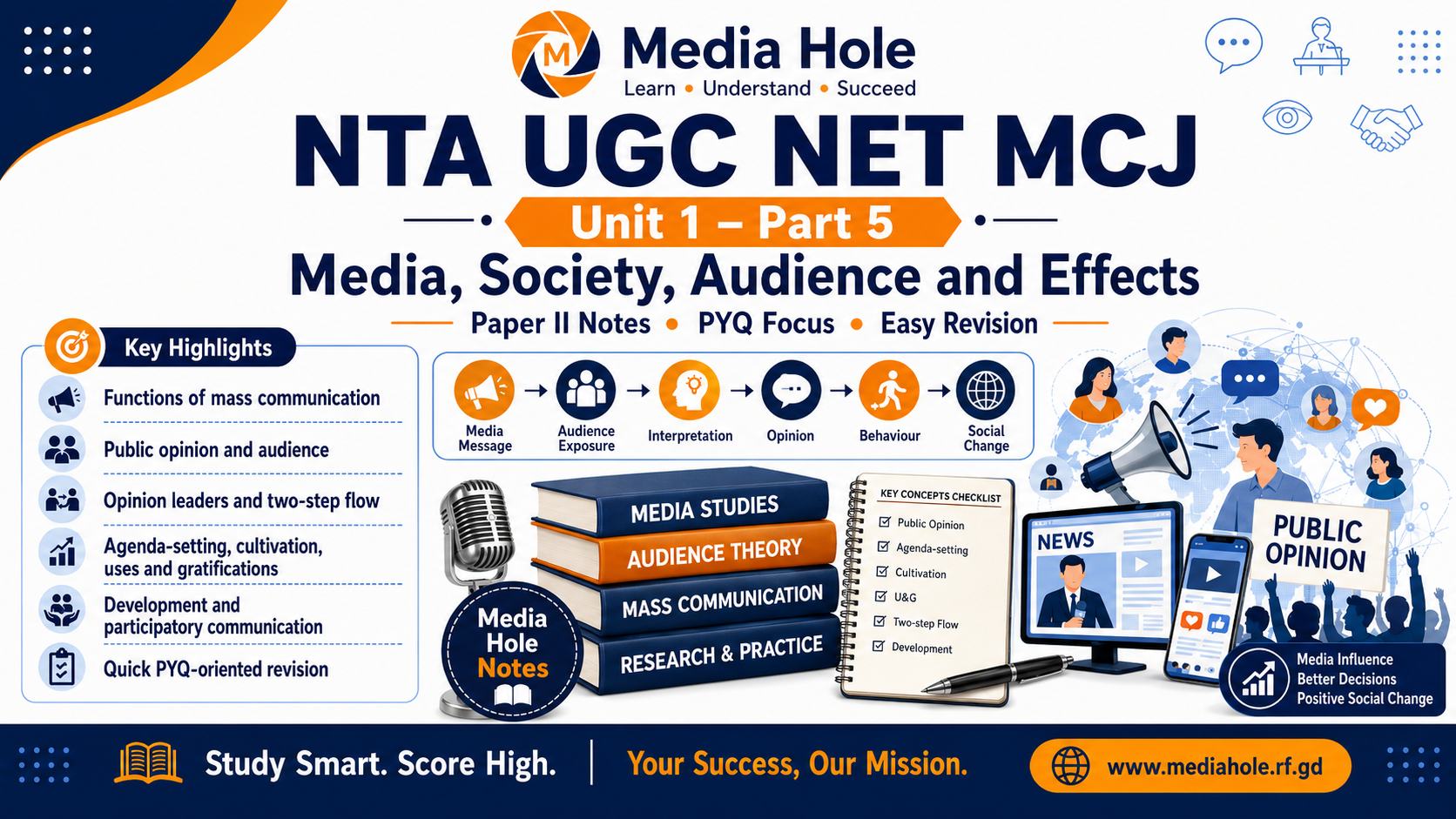
Part 5: Media, Society, Audience and Effects
1. Topic at a Glance
| Area | What to Learn | PYQ Importance |
|---|---|---|
| Functions of mass communication | Information, surveillance, correlation, education, entertainment, continuity and mobilisation. | Asked through functional analysis and role of media. |
| Media and society | Media influence on social change, culture, democracy, participation and development. | Useful for conceptual and assertion-reason questions. |
| Audience | Active audience, passive audience, audience needs, selective exposure and interpretation. | Linked with uses and gratifications and reception-based questions. |
| Opinion leaders | Two-step flow, interpersonal influence and diffusion of ideas. | Repeated PYQ area. |
| Media effects | Magic bullet, limited effects, agenda-setting, cultivation, dependency and spiral of silence. | Highly important for NET MCJ. |
| Development communication | Diffusion, participation, sustainable development and social dialogue. | Frequently asked from 2006–2018 PYQs. |
2. Infographic Flow: Media, Society and Effects
3. Functions of Mass Communication
Mass communication performs several social functions. It informs people, interprets events, entertains audiences, transmits culture, mobilises citizens and supports social change.
| Function | Meaning | Example |
|---|---|---|
| Information | Providing facts, news and updates. | News bulletins, reports, alerts. |
| Surveillance | Monitoring the environment and warning society. | Disaster alerts, election updates, weather reports. |
| Correlation | Explaining and interpreting events. | Editorials, analysis, expert discussion. |
| Transmission of culture | Passing values, traditions and social norms. | Cultural programmes, documentaries, festivals coverage. |
| Entertainment | Providing relaxation, pleasure and recreation. | Cinema, music, sports, serials, online videos. |
| Mobilisation | Encouraging people to act for a cause or issue. | Health campaigns, voting awareness, social campaigns. |
4. Media and Society
Media and society influence each other. Media reflect social realities, but they also help shape public debate, culture, political awareness, consumer behaviour, social values and collective memory.
| Role of Media | Societal Importance |
|---|---|
| Watchdog role | Questions authority and exposes wrongdoing. |
| Forum role | Provides space for debate and discussion. |
| Educational role | Spreads knowledge, awareness and literacy. |
| Cultural role | Represents language, identity, tradition and lifestyle. |
| Developmental role | Supports health, agriculture, education, environment and social change. |
5. Public Opinion
Public opinion refers to the collective view, judgement or attitude held by people about public issues. Media influence public opinion by selecting issues, framing debates, giving visibility to voices and providing information.
6. Audience: Passive, Active and Selective
Earlier media effects theories often viewed the audience as passive. Later approaches viewed the audience as active, selective and interpretive. Active audiences choose media, interpret messages and use content according to their needs.
| Audience View | Meaning | Linked Theory |
|---|---|---|
| Passive audience | Audience is directly influenced by powerful media. | Magic bullet / hypodermic needle view. |
| Active audience | Audience selects, interprets and uses media content. | Uses and gratifications. |
| Selective audience | Audience prefers messages that support existing views. | Selective exposure / selective perception. |
| Interpretive audience | Different audiences may read the same text differently. | Reception analysis / encoding-decoding angle. |
7. Opinion Leaders and Two-step Flow
The two-step flow theory says media influence often moves first from mass media to opinion leaders and then from opinion leaders to other people through interpersonal communication.
| Concept | Meaning |
|---|---|
| Opinion leader | A person who influences the opinions and behaviour of others. |
| Personal influence | Interpersonal influence that affects decision-making. |
| Two-step flow | Media → opinion leaders → wider audience. |
| Limited effects | Media influence is shaped by social relationships and prior attitudes. |
8. Media Effects: From Powerful Media to Active Audience
| Effect Tradition | Main Idea | Examples |
|---|---|---|
| Powerful effects | Media can directly and strongly influence audiences. | Magic bullet / hypodermic needle. |
| Limited effects | Media effects are limited by personal influence, social groups and selective exposure. | Two-step flow, opinion leaders. |
| Long-term effects | Media gradually shape perceptions and social reality. | Cultivation, agenda-setting, dependency. |
| Active audience | Audience uses media to satisfy needs and interpret meanings. | Uses and gratifications, reception analysis. |
9. Magic Bullet / Hypodermic Needle Theory
The magic bullet or hypodermic needle view assumes that media messages directly influence passive audiences. It is associated with the early powerful-effects tradition.
10. Agenda-setting Theory
Agenda-setting theory argues that media may not always tell people what to think, but they strongly influence what people think about. It deals with issue salience and media priority.
| Agenda-setting Element | Meaning |
|---|---|
| Media agenda | Issues highlighted by media. |
| Public agenda | Issues considered important by the public. |
| Issue salience | Importance given to an issue. |
| Framing link | How the issue is presented or interpreted. |
11. Cultivation Theory
Cultivation theory, associated with George Gerbner, focuses on the long-term effects of television exposure. It argues that heavy viewers may gradually come to see social reality in ways shaped by television content.
| Term | Meaning |
|---|---|
| Heavy viewers | People who watch television for long periods. |
| Light viewers | People who watch less television. |
| Mainstreaming | Different audience groups gradually develop similar views due to television exposure. |
| Resonance | Media message becomes stronger when it matches the viewer’s lived experience. |
| Mean world syndrome | Heavy exposure to violent content may make the world appear more dangerous. |
12. Uses and Gratifications Theory
Uses and gratifications theory views audiences as active users of media. It asks why people use media and what needs they satisfy through media consumption.
| Need / Gratification | Example |
|---|---|
| Information | Using media to know current events. |
| Personal identity | Using media to connect with values or role models. |
| Social interaction | Using media to discuss and connect with others. |
| Entertainment | Using media for relaxation, pleasure and escape. |
13. Media Dependency Theory
Media dependency theory argues that media effects become stronger when individuals or societies depend heavily on media for information, orientation and understanding.
14. Spiral of Silence
Spiral of silence theory, associated with Elisabeth Noelle-Neumann, explains how people may remain silent when they feel their opinion is in the minority because of fear of isolation.
15. Diffusion of Innovations
Diffusion of innovations theory, associated with Everett M. Rogers, explains how new ideas, technologies and practices spread through a social system over time.
| Adopter Category | Meaning |
|---|---|
| Innovators | First to try new ideas. |
| Early adopters | Influential users who adopt early. |
| Early majority | Adopt before the average person. |
| Late majority | Adopt after many others have already adopted. |
| Laggards | Last or resistant adopters. |
16. Development Communication
Development communication is the planned use of communication for social and economic development. It includes awareness, participation, behaviour change, empowerment, social dialogue and community-level transformation.
| Approach | Main Idea |
|---|---|
| Dominant paradigm | Top-down modernisation and diffusion-oriented approach. |
| Diffusion approach | Spread of innovations through media and change agents. |
| Participatory approach | People participate in defining problems and creating communication. |
| Communitarian approach | Emphasises horizontal communication and community-based development. |
| Sustainable development communication | Focuses on long-term social, environmental and participatory change. |
17. Participatory Communication
Participatory communication means people are not treated only as receivers. They participate in problem identification, message creation, decision-making and evaluation.
18. PYQ Mapping Table
| PYQ Source | Question Area | What to Revise |
|---|---|---|
| September 2013 Paper II | Functions of media | Information, correlation, continuity, entertainment and mobilisation. |
| June 2012 Paper III | Functional analysis | Charles R. Wright and media functions. |
| July 2018 Paper II | Public opinion | Public opinion as temporary/incomplete consensus; Walter Lippmann and media effects. |
| December 2011 Paper II | Public opinion | Majority opinion is not necessarily public opinion. |
| June 2015 Paper III | Selective exposure and opinion leaders | Selective exposure, voter study, influence of opinion leaders and limited persuasive effects. |
| July 2016 Paper III | Two-step flow and status conferral | Two-step flow field; Lazarsfeld and Merton’s status conferral function. |
| June 2014 Paper III | Two-step flow | People are not social isolates; opinion influence matters. |
| January 2017 Paper III | Magic bullet / media effects | Instant and direct effects of media; theory sequence including dependency and U&G. |
| July 2016 Paper III | Magic bullet and mass society | Powerful media institutions and uniform mass society assumption. |
| December 2012 Paper III | Cultivation theory | Gerbner, heavy viewers, light viewers, mainstreaming and resonance. |
| June 2009 Paper II | Uses and gratifications | Viewer motivation and active audience approach. |
| December 2006 Paper II | Uses and gratifications | Blumler and Katz’s four main media-use purposes. |
| November 2017 Paper III | Media Dependency Theory | DeFleur and Ball-Rokeach. |
| December 2009 Paper II | Spiral of Silence | Noelle-Neumann and fear of isolation. |
| June 2008 / June 2013 Paper | Diffusion of innovations | Rogers’ stages: knowledge, persuasion, decision, implementation, confirmation. |
| December 2015 Paper III | Development communication | Nora C. Quebral; adopter categories and laggards. |
| September 2016 Paper III | Development communication | Communitarian strategy, horizontal communication and revolution of rising expectations. |
| July 2018 Paper II | Participatory communication | Structural change, sustainable development and social dialogue. |
19. Question-Type Infographic
| Question Type | Example Area | Revision Strategy |
|---|---|---|
| Direct factual | Nora Quebral, Noelle-Neumann, DeFleur and Ball-Rokeach, Gerbner. | Prepare scholar-theory table. |
| Assertion-reason | Magic bullet, public opinion, participatory communication. | Understand the logic behind each theory. |
| Match the following | Theory ↔ scholar, function ↔ theorist, approach ↔ concept. | Revise mapping tables. |
| Chronology | Diffusion of innovations stages. | Memorise the flow sequence. |
| Concept application | Audience needs, opinion leaders, public opinion, sustainable development. | Link definitions with examples. |
20. Quick Revision Sheet
| Concept | One-line Revision |
|---|---|
| Public opinion | Collective public judgement on public issues; not simply majority opinion. |
| Opinion leader | Influential person who interprets media messages for others. |
| Two-step flow | Media → opinion leaders → audience. |
| Magic bullet | Direct powerful media effect on passive audience. |
| Agenda-setting | Media tell people what to think about. |
| Cultivation | Long-term TV exposure shapes perception of reality. |
| Uses and gratifications | Audience actively uses media to satisfy needs. |
| Media dependency | Media effects increase when people depend heavily on media. |
| Spiral of silence | People may stay silent if they fear isolation. |
| Diffusion of innovations | New ideas spread through social systems over time. |
| Participatory communication | People participate in the communication process and development. |
21. Practice Questions with PYQ Angle
Answer: Collective public judgement or attitude on a public issue.
PYQ Angle: July 2018 Paper II and December 2011 Paper II.
Answer: Influential people who receive, interpret and pass media messages to others.
PYQ Angle: Two-step flow and limited effects questions.
Answer: Two-step flow theory.
PYQ Angle: July 2016 Paper III and June 2014 Paper III.
Answer: Cultivation theory.
PYQ Angle: December 2012 Paper III and July 2018 Paper II.
Answer: Active audience needs and media-use motivations.
PYQ Angle: December 2006 Paper II, June 2009 Paper II and June 2012 Paper III.
Answer: DeFleur and Ball-Rokeach.
PYQ Angle: November 2017 Paper III.
Answer: The process through which new ideas or technologies spread in a social system over time.
PYQ Angle: June 2008 Paper II, June 2013 Paper III and December 2015 Paper III.
22. Final Unit 1 Completion Note
With this part, Unit 1 is complete for our website-note sequence. The most important final revision strategy is to memorise model-author, theory-scholar, media firsts and years, non-verbal terms, and PYQ-linked media effects theories.