
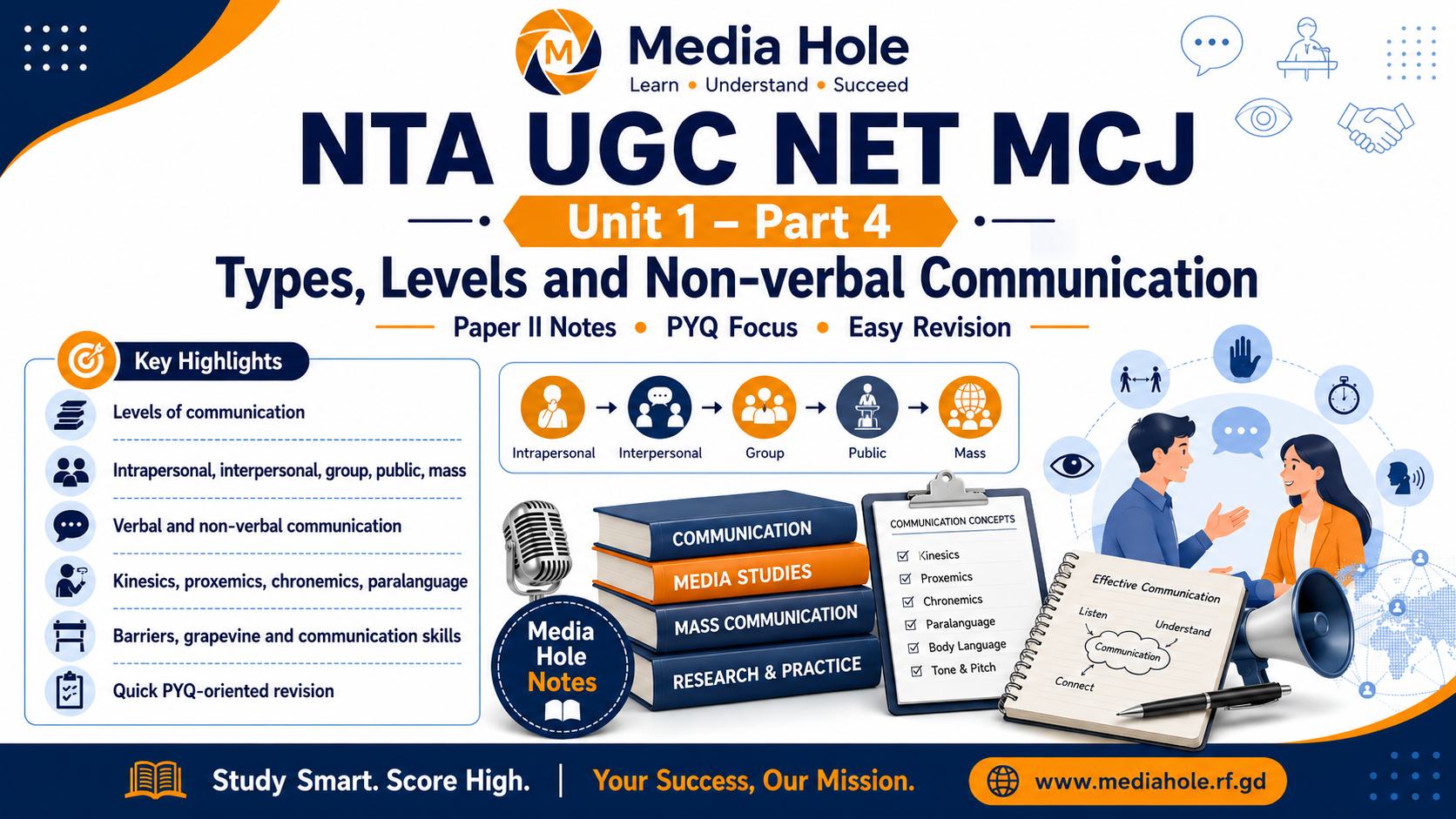
Part 4: Types, Levels and Non-verbal Communication
1. Topic at a Glance
| Area | What to Learn | PYQ Importance |
|---|---|---|
| Levels of communication | Intrapersonal, interpersonal, group, public and mass communication. | Direct factual and comparison questions. |
| Verbal communication | Oral and written use of language. | Often linked with communication skills and message clarity. |
| Non-verbal communication | Body language, gestures, facial expressions, space, time, silence and appearance. | Repeatedly asked in PYQs. |
| Barriers | Physical, emotional, linguistic, semantic, cultural and social barriers. | Common concept-identification area. |
| Informal communication | Grapevine and rumour-based communication. | Asked as direct term-identification question. |
2. Infographic Flow: Levels of Communication
3. Levels of Communication
| Level | Meaning | Example |
|---|---|---|
| Intrapersonal communication | Communication within oneself. | Thinking, self-talk, decision-making, reflection. |
| Interpersonal communication | Communication between two people or a small number of persons. | Conversation, interview, counselling, discussion. |
| Group communication | Communication among members of a group. | Classroom discussion, committee meeting, team briefing. |
| Public communication | One speaker addresses a larger audience. | Lecture, public speech, press conference. |
| Mass communication | Message reaches a large, scattered and heterogeneous audience through media technology. | Newspaper, radio, television, cinema, websites and social media. |
4. Intrapersonal Communication
Intrapersonal communication is communication within the individual. It includes thinking, internal dialogue, interpretation, imagination, self-evaluation and decision-making.
5. Interpersonal Communication
Interpersonal communication is direct communication between persons. It is usually face-to-face or person-to-person, though it may also happen through mediated channels such as phone calls or video calls.
| Feature | Explanation |
|---|---|
| Direct interaction | Participants can immediately respond to each other. |
| Immediate feedback | Feedback may be verbal or non-verbal. |
| Relationship-based | Trust, emotion and social context influence the message. |
| Phatic stage | The initial stage of interpersonal communication involves social opening and relationship contact. |
6. Group Communication
Group communication takes place among members of a group who interact to share information, solve problems, make decisions or coordinate action.
| Type | Example |
|---|---|
| Small group communication | Committee meeting, team discussion, study group. |
| Large group communication | Class lecture, seminar, organisational gathering. |
| Dialogic communication | Participatory discussion where members exchange views. |
7. Public Communication
Public communication involves a speaker or communicator addressing a relatively large audience. It is more structured than interpersonal communication and often requires planning, presentation skills and audience awareness.
- Public speech
- Lecture
- Seminar presentation
- Press conference
- Public campaign address
8. Mass Communication
Mass communication uses technological channels to reach a large and heterogeneous audience. It involves organised message production, gatekeeping, editing, distribution and audience reception.
9. Verbal Communication
| Type | Meaning | Example |
|---|---|---|
| Oral communication | Communication through spoken language. | Speech, interview, discussion, announcement. |
| Written communication | Communication through written language. | Letter, article, report, email, press release. |
10. Non-verbal Communication
Non-verbal communication is communication without words. It includes body language, facial expressions, gestures, posture, eye contact, space, touch, silence, appearance, voice quality and use of time.
| Category | Meaning | Example |
|---|---|---|
| Kinesics | Study of body movements. | Gestures, posture, facial expressions. |
| Proxemics | Study of space and distance in communication. | Personal distance, social distance, public distance. |
| Chronemics | Use of time in communication. | Waiting time, punctuality, time pressure. |
| Paralanguage | Vocal features other than words. | Tone, pitch, speed, pause, volume. |
| Haptics | Communication through touch. | Handshake, pat, touch. |
| Oculesics | Eye behaviour in communication. | Eye contact, gaze, eye movement. |
| Artifacts | Objects and appearance used to communicate meaning. | Dress, hairstyle, ornaments, symbols. |
11. Verbal vs Non-verbal Communication
| Verbal Communication | Non-verbal Communication |
|---|---|
| Uses words and language. | Uses signs, gestures, space, appearance and body behaviour. |
| Can be oral or written. | Can be visual, bodily, spatial or vocal. |
| Meaning is more direct. | Meaning depends strongly on context and culture. |
| Example: speech, article, email. | Example: smile, silence, eye contact, posture. |
12. Communication Barriers
Communication barriers are obstacles that disturb the flow of meaning between sender and receiver. They may occur at the level of language, emotion, culture, technology, organisation or physical environment.
| Barrier | Meaning | Example |
|---|---|---|
| Physical barrier | External disturbance or environmental problem. | Noise, distance, poor seating, bad signal. |
| Semantic barrier | Problem caused by meaning of words. | Ambiguous words, jargon, multiple meanings. |
| Linguistic barrier | Language-related difficulty. | Different languages, translation errors. |
| Emotional barrier | Feelings that block understanding. | Fear, anger, anxiety, distrust. |
| Social / cultural barrier | Differences in social values, status, beliefs or customs. | Stereotypes, prejudice, cultural misunderstanding. |
| Organisational barrier | Problems in structure or hierarchy. | Rigid chain of command, delay, filtering. |
| Technological barrier | Failure or limitation of communication technology. | Poor internet, audio failure, platform issue. |
13. Formal, Informal and Grapevine Communication
| Type | Meaning | Example |
|---|---|---|
| Formal communication | Communication through official channels. | Official memo, circular, meeting notice. |
| Informal communication | Unofficial communication outside formal channels. | Casual discussion, informal update. |
| Grapevine communication | Informal communication network where rumours or unofficial information spread. | Workplace gossip, unofficial news chain. |
| Horizontal communication | Communication among people at the same level. | Communication between colleagues or departments. |
| Vertical communication | Communication up or down the hierarchy. | Manager to employee; employee to manager. |
14. Communication Skills
| Skill | Why It Matters |
|---|---|
| Listening | Helps understand the message, context and feedback. |
| Speaking | Helps present ideas clearly and confidently. |
| Reading | Helps understand written information and media texts. |
| Writing | Important for reports, articles, scripts, news and official communication. |
| Feedback | Confirms whether the message has been understood. |
15. PYQ Mapping Table
| PYQ Source | Question Area | What to Revise |
|---|---|---|
| September 2013 Paper III | Non-verbal communication | Signs in non-verbal communication; presentational codes. |
| December 2012 Paper III | Body language and signs | Body language as presentational media; facial expressions and body language as signs. |
| September 2016 Paper III | Proxemics / Edward Hall | Edward Hall is associated with the study of space in communication. |
| November 2017 Paper III | Interpersonal communication | Initial stage of interpersonal communication: phatic stage. |
| December 2014 Paper III | Interpersonal communication and conflict | Imbalance in interpersonal communication may create conflict. |
| June 2014 Paper III | Mass communication level | Large number of people involved in message production indicates mass communication. |
| September 2016 Paper III | Communication barriers | Off-limit topics and communication barriers. |
| September 2016 Paper III | Grapevine communication | Rumour/gossip flow through informal networks. |
| September 2016 Paper III | Horizontal communication | Horizontal communication in communitarian/development context. |
| July 2016 Paper III | Social codes and facial expression | Speech, facial expression and social codes in media texts. |
| July 2018 Paper II | Listening in communication process | Research-listening as part of the public relations process sequence. |
16. Question-Type Infographic
| Question Type | Example Area | Revision Strategy |
|---|---|---|
| Direct factual | Edward Hall, phatic stage, body language, grapevine. | Prepare term-author and term-meaning list. |
| Assertion-reason | Interpersonal communication and conflict. | Understand concept, not just definition. |
| Match the following | Communication types and examples. | Revise comparison tables. |
| Concept identification | Barrier type, non-verbal category, communication level. | Learn examples for each concept. |
| Passage-based | Social codes, facial expression and media meaning. | Practise applying theory to text. |
17. Frequently Repeated Question Areas
18. Quick Revision Sheet
| Term | Quick Meaning |
|---|---|
| Intrapersonal | Communication within oneself. |
| Interpersonal | Communication between persons. |
| Group communication | Communication among members of a group. |
| Mass communication | Communication to large audience through media technology. |
| Kinesics | Body movement communication. |
| Proxemics | Use of space and distance. |
| Chronemics | Use of time in communication. |
| Paralanguage | Tone, pitch, volume and vocal features. |
| Grapevine | Informal communication network. |
| Communication barrier | Obstacle that affects message understanding. |
19. Practice Questions with PYQ Angle
Answer: Communication within oneself.
PYQ Angle: Level-of-communication identification.
Answer: Phatic stage.
PYQ Angle: November 2017 Paper III.
Answer: Proxemics.
PYQ Angle: September 2016 Paper III.
Answer: Informal communication network through which rumours or unofficial messages spread.
PYQ Angle: September 2016 Paper III.
Answer: Facial expression and body language.
PYQ Angle: December 2012 Paper III and September 2013 Paper III.
Answer: Mass communication.
PYQ Angle: June 2014 Paper III.
20. Final Exam Tip
For this topic, revise by using three tables: levels of communication, non-verbal categories and barriers with examples. PYQs usually ask this area through direct identification, matching, assertion-reason or concept application.